Online Courses Now Available!

person jumping in excitement in the air in front of the sunset. Some trees and hills noticed.

Online Courses Now Available!

EEEEEKKKK Folks! I am sooo excited to share with you that my online courses are now available for purchase!

While they aren’t all available just yet, three of the most commonly talked about concerns in my practice are.!

I am very excited to share that the Mini Crash Course in Anxiety, Stress, and Anger are all available immediately!

For those of you who have been following along, these Crash Courses in Anxiety, Stress, and Anger, are part of the Crash Course in Mental Wellness Series that I have been working on over the past couple of years.

I was called to create these courses for a handful of reasons:

  1. When I am working, I commonly see folks accessing counselling services through their extended health benefits or out of pocket payments, and sessions were limited; therefore limiting their opportunities to get to the route causes of their concerns and only getting the band-aid tools to help manage in the moment. I wanted to be able to offer something to folks that helped them get more for their money and time.
  2. I was on (my first) maternity leave and knew the clients who wanted to wait for me to come back deserved something to support themselves while I was away.
  3. When I came back to work, I still had people waitlisted for services and I hated that they were waiting to get support because I didn’t have the space to bring them in when they needed it.
  4. I am again on (my last) maternity leave and I continue to get requests from new clients asking for support, but I cannot accommodate them at this time as I am not yet back to work, and continue to hold a waitlist for services.

Please hear me when I say I HATE it that I cannot offer services at this time for folks asking for it. It takes immense courage to recognize the needs for support and I went in to this field to be that person people could turn to in times of need.

So to help balance these needs, I plugged into my computer while my littles slept, to create an option where I could share the top skills and information I use and teach to folks in need of help right now.

In each of these courses, I offer you some of the most commonly used skills I share with clients to help them with their anxiety, and I hope that they are helpful for you too!

Each course is geared to help folks at any time of day, from the comfort of your own home, with quick skills that can change your experience immediately, even if just a bit to get you through.

Each course comes with at least a handful of skills, sold for less than the cost of one counselling session, and will take about an hour of your time to get through.

So if you, or someone you know is looking for mental health support and would like to create a foundation of skills before or along side engaging in counselling, check out this, and the upcoming, courses that will be available!

And of course, I would be ever so grateful if you wanted to share the announcement of these courses with your friends and family!

As always, I would love to hear your thoughts and feedback, and would deeply appreciate it if you chose to share these options with others who might need the support too. Feel free to devanceciliacounselling@gmail.com

It’s Almost Here!

computer screen reads 'learn at your own pace crash course to mental wellness series with DevanCecilia Counselling read and practice from the comfort of your home visit www.devanceciliacounselling.com'

It’s almost here! It’s almost here!

I am incredibly excited to share with you some long awaited big news: the Crash Course to Mental Wellness Series is almost here!

After going back to work put a year-long delay in launching – the time has finally come back around, and this time it’s better! It’s better because it is redesigned to serve you for your specific needs!

This offering now comes as a mini series of 6 different topics to support your mental wellness- anger, anxiety, stress, depression, mindfulness, and grief.

Want to learn more about it?

Originally designed as one big course, I recognized that not everyone needs or wants all of the information. You, for example, might be interested in one or two of the topics but not all of it. So why would I overwhelm you with a bunch of information you didn’t want?

Instead, I have redesigned the information to be shared in 6 different mini courses. All online, all go at your own pace, and all set up in an easy to read, easy to learn and practice way.

In this series I share my most favourite skills to practice myself, and with my one-to-one clients.

Think if it as a series of counselling sessions at the comfort and leisure of your own pace and time – no need to have a scheduled appointment! You can do this whenever it suits you best.

If you would like to get on the email list to be notified when the courses go live – sign up here! I can’t wait to share this information with you!

I’ve had quite the year running my counselling business…

Devan standing holding pregnant belly

Hello everyone!

I’ve had quite the year running my counselling business…and it’s been some time since I last connected – I apologize for that! A lot has been going on!

For those of you who might not follow me on social media, I have had quite the year.

When I was posting more frequently to you previously, I was on my first maternity leave, and had some time to play catch up on sharing the information I have in my head to those who are interested 😊

However, as I geared up to go back to work, I changed some programming for my business and then hit the ground running – back to work full time with an agency, and working in my business in the evenings again – only this time with a toddler.

As much as I was working to balance it and keep this going – wouldn’t you know it, we were blessed with another pregnancy! That also mean less energy and time for me – so my blog writing was the piece that took the first pause.

Now that I am on my second  (and final!) maternity leave, I am so thrilled to be back here, sharing information with you about topics and I am passionate about.

One topic I really want to bring forward was how actually to find a counsellor. I am redirecting folks weekly on how to find a counsellor, and hope that this bit of information might be helpful for anyone in BC looking for some help.

When looking for a counsellor, there are a few ways to go about it.

  1. Google – you type in something like ‘counsellor Chilliwack’ and see a whole list of folks who practice in Chilliwack – yahoo! You’ve started with a list. However, now you have to go through all of their websites to see if they work with the concerns that are bringing you to counselling. This is a lot of time, and might be even more of your time if you reach out to them and they share that they are currently not taking on new clients.
  2. Word of mouth – now while this is an excellent way to find a counsellor (as they come vetted by someone you most likely trust) – however they too might not work with the concerns that bring you to counselling, or taking on new clients, or even so they might not be able to take you on because of a conflict of interest with the person who referred you (not always but it happens).
  3. Look someone up from a directory – this can be a bit of work as you also have to read through websites/profiles and contact them to connect. HOWEVER, directories also have a space where the therapist can note if they are currently accepting clients, waitlisting clients, or not accepting clients. This aspect alone can save you quite a bit of time and browsing just by ruling out who cannot help you at this time.

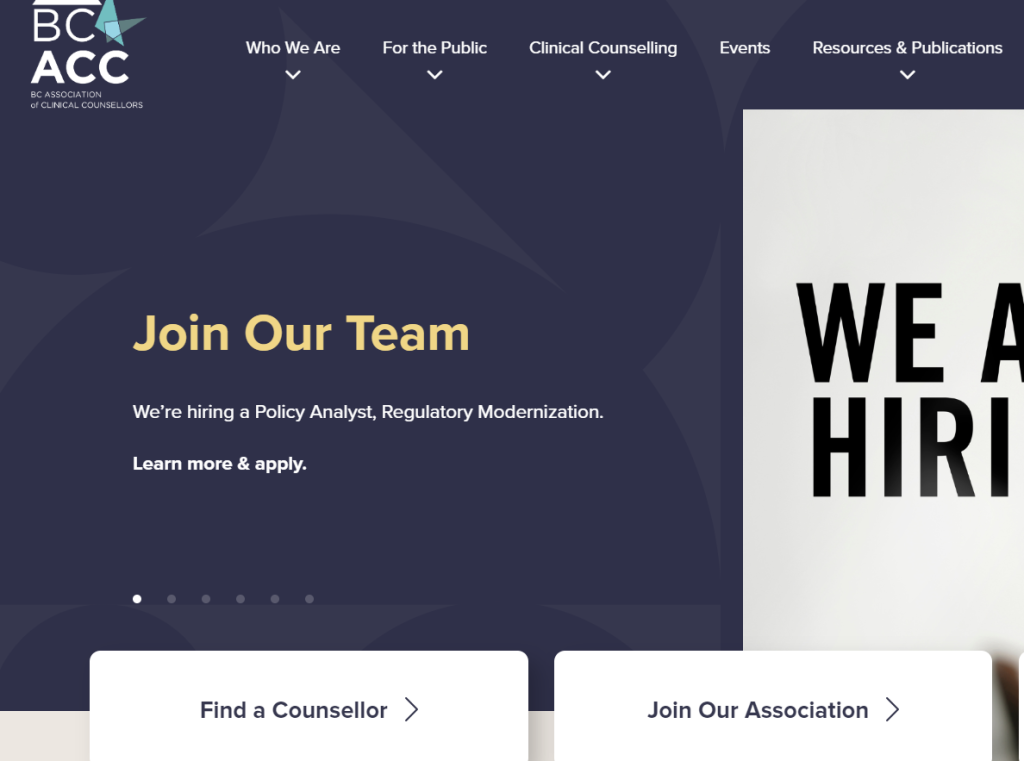
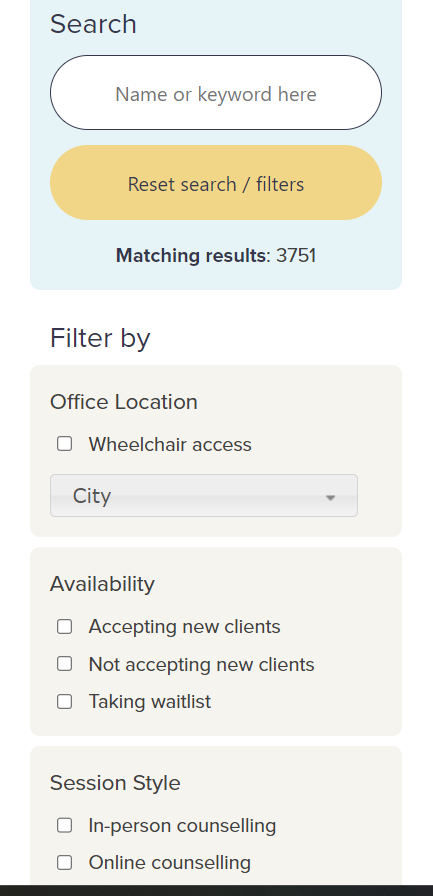
To help you find someone who is a good fit, I want to bring your attention to my college directory – BCACC, which stands for the BC Association of Clinical Counsellors. It’s a lovely website for counsellors registered in BC (the BC regulation body). It also has a really great updated find a counselor tool to help folks find a good fitting counselling. By using the filtering process, it can really help to narrow down your search in finding a good fitting counselor for you and your needs at this time. I’ve put a picture here as on the blog to give you a reference on what that will look like but just to go through it. It really is this wonderfully updated program that really helps to narrow down the search you can go off by whether or not you want to see someone online or in person, which community you want to see them in, and it also has a great new feature of folks who are currently not accepting clients, waitlisting clients, and actively accepting referrals. So when you’re looking for a counsellor I would really recommend choosing the actively looking actively accepting clients or the waitlisted options just because it will then weed out anybody who’s not currently taking on new clients.

It will help to really narrow down that the people that you are searching for are indeed able to take yours on their caseload in some capacity in now or in the upcoming months.

Another great option is if you have any funding in particular so if you’re coming through ICBC or First Nations Health Authority, or Crime Victim’s Assistance Program. There is a way to funnel through and also make the list smaller to be able to prioritize who accepts those services and those funding sources so that you’re not having to do the hard work of asking everybody you phone or e-mail trying to see if someone will take that funded session for you.

Once you’ve clicked and selected all the options that you’re interested in, and things that are important for you in your search, it will give you the candidates that are best suited for you, if that person exists in the request that you’re asking.

One thing that can happen is that the list can be zero options. If my list shows nothing, it might mean going back to the filters and noting anything there that you might be willing to compromise on or is there a different way of asking for what you need.

For example, sometimes you might be really particular about the specific issue you’re having and clinicians who could support you maybe noted the generalized version, instead of the specific topic (ie they might have chosen stress as a generic option but you’ve chosen workplace stress). Another option is also opening you search for anyone who’s also waitlisting clients as well. Waitlisting can be as short as a couple of weeks and as long as a few months, depending on the practitioner, so it’s really about allowing yourself that opportunity to have an option available if it OK that you wait a little bit in order to seek those services.

The last piece could be assessing whether you are willing to go virtual or outside of your community if your request was in person, or in town only. By broadening your location options, it can really be helpful to help you find a good fitting counsellor.

As always, I encourage everyone to shop around for counsellors- fill out their intake forms, take a look at their websites, and if they have any videos on there or social media platforms in which they share information. Take a look at them see if this is a person that you want to sit next with and you want to start talking about your personal experiences with. Your counsellor should be someone you feel safe with, or at least someone you are willing to create safety with; someone who seems knowledgeable enough for what you’re wanting.

Another piece that might be helpful in determining a good fit, is if they offer that free 15-minute consultation, then you can always contact them up and ask them for to schedule that or to look on their website and to see if you can schedule that yourself. That way you also get an opportunity to chat with them and see how you feel about working with them.

Folks too will offer on initial assessment option. Now this is a paid appointment, however when you talk with those clinicians if you decide it’s not a good fit or maybe they acknowledge that they’re not the best fit for you, that session it’s not a waste of time but a great piece of information gathering. That is because the clinician can then provide you with other resources or names of folks that might be better suited for you so you’re not walking away empty handed.

Once you have found somebody to make an appointment with, follow through on that and give yourself the opportunity to connect and get to working on the concerns that are bothering you.

Now I’ve said this before in previous posts, but if you’re in that appointment and it doesn’t feel comfortable, or you are not really feeling a connection with that person – don’t waste your time, and don’t waste your money (funding). Cultivating a really good relationship with your counsellor is very important because that’s going to be the foundation in which you’re going to get the most benefit and the most support no matter what other options you’re looking for in the therapeutic setting.

If you have any questions or if you’re looking for some referral sources you know I’m happy to support your journey and offer options to connect with!

…Stay tuned, and watch your emails as I have got some really awesome things in the works coming soon! I have a couple of freebies, courses, and handouts that I’ve put together and I’m just doing the back-end pieces to make them available.

This week was a lot

This week was a lot.

There were a lot of dates and information in the media this week. We have been made aware of annual dates of awareness and remembrance, possible changes in the legislation that could lead to devastating results, and really tough days to navigate. My hope in highlighting some of them that it will bring awareness to a lot of what has been on each of our minds this week and what you can do to help cope with the overload. 

Mental Health Awareness

It started off with the beginning of Mental Health Awareness month in the US, and Mental Health Awareness week in the US. A great campaign to bring forward the importance of taking care of our thoughts and emotions. 

MMIWG2S

Then the National Day of Awareness for Missing and Murdered Indigenous Women and Girls and Two-Spirit People (MMIWG2S). A day established because of Hanna Harris, a citizen of the Northern Cheyenne Tribe, who went missing on July 4, 2013 and was found dead three days later by volunteers. May 5 was chosen by the National Indigenous Women’s Resource Center (NIWRC) as it was Hanna Harris’ birthday. 

Roe v. Wade

And we can’t forget the devastating news coming from the US Supreme Court appearing poised to strike down Roe v. Wade, the legal case establishing the right to an abortion, resulting in a cascade of proposed restrictive abortion legislation.

Mother’s Day

And today is Mother’s Day in Canada. A day that can feel so great for those with mothers or who are mothers.

Mother’s day can be a source of great pain and difficulty however for:

  • Those who are longing to be moms
  • Those whose babies died during gestation
  • Those whose children have died
  • Those who do not have access to their children
  • Those who have strained relationships with their moms
  • Those who have strained relationships with their children
  • Those whose moms have died

Ongoing worldly concerns

All of this is of course on top of the ongoing wars and access restrictions, the ongoing discovery and count of unmarked graves at former Residential School sites, ongoing issues with access to clean drinking water on Indigenous lands, discrimination, inflation, a housing crisis, gas prices and oh yeah – the pandemic. 

How to cope

It’s A LOT! Maybe even more than you feel you are able to manage at the moment. 

So what can you do to cope?

Here are my top encouragements:

  1. Take a break from social media and news outlets. This can be incredibly helpful in the moment. Pausing your access to current events and information can reduce stress and feeling overwhelmed. Take as much time as you can (a day, a few days, a week, whatever works for you).
  2. Do whatever it is that soothes you. Self-care, self-care, self-care here folks! A bath, a walk outside, knitting/crochetting/quilting etc, arts and crafts, puzzles, a massage… the options are endless, and the benefits are tremendous.
  3. Connect with your supports. You are not meant to live this life alone, or to manage everything by yourself. Connect with those who make you feel good and who can support your need for a pause from current events.
  4. Reflect on where you live and focus on what impacts you directly (for now). It can be really helpful and important to reflect on where you live when hearing everything that is going on in the news. With modern technology it can feel like current events are happening directly to you when they aren’t. You can ask yourself: Where in the world am I right now? Is that happening in this country/city/etc right now? What do I need to do to stay safe?
  5. Create change or give back. Feel called to change what is happening around you or in the world? Take that motivation to make change and impact the lives of others for the better! Find places to volunteer, donate, or create a change you see is needed. 
  6. Have fun! You’ve heard me say this before – having fun is the easiest and quickest way to fill our cup of capabilities and resilience. It’s important that you have fun to fill your cup so that you can continue to make a difference in your life. 

If you are struggling at all with what is going on in the world, I hope this helps. And for those experiencing any difficulty with Mother’s Day, may you feel supported and connected as you navigate the day as best as you can.

Let’s stay connected!

If this is something that you are struggling with, and would like to work on it with a counsellor, visit the Contact Me link on my website to schedule an appointment today.

If you want more information, skills and support with your mental health, make sure to sign up for my email list to hear about my upcoming online Course in Mental Health!

Know someone who might benefit from reading this information? Feel free to share this with them, and encourage them to sign up for my blog emailed directly to them!

And don’t forget to follow me on Instagram or Facebook @devanceciliacounselling for daily supports and information!


photo cred: Road Trip with Raj

Pick Me Up!

Ever need a Pick Me Up?

Have you even needed a mental pick me up? A change of thoughts? Or a shift in mindset?

I know I have! And music has regularly been that supportive pick me up when I needed it.

When I had my first child I really wanted to create a set of songs that could do that for them. A playlist that they could play to remind them of their strengths, capabilities and help build their confidence; all while shifting negative thoughts and feelings that might be present.

Thich Nhat Hahn said “If you really know how to live, what better way to start
the day than with a smile? Smiling helps you approach the day with gentleness and understanding. Smile with your whole being.”

So we play this set of songs every morning because it makes us smile, it helps build skills, and it shift our moods.

*Happy bonus: not only does it help my kiddo, it helps me too!

Now, I’m not one to keep such helpful things to myself, so I’m sharing it with you all here!

Below is the list of songs currently on the playlist. I hope these songs help shift moods and builds skills for you!

Songs

Try everything – Shakira

How far ill go – Auli’i Cravalho

A Million Dreams – Ziv Zaifman, Hugh Jackman

Get Back Up Again – Anna Kendrick

Beautiful- Christina Aguilera

Never Ever Give Up – Matthew West

Born This Way – Lady Gaga

I AM WOMAN – Emmy Meli

Happy – Pharrell Williams

Cloudy Day – Tones and I

Brave – Sara Bareilles

Fight Song – Rachel Platten

This Is Me – Keala Settle

Mind My Business – Travis World

Live Your Story – Auli’i Cravalho

Got any songs that help you or your kiddos? If would love to know about them! Help me grow our playlist and pick me up songs! Feel free to send me an email and let me know what you’re listening to when you need a boost!

Let’s stay connected!

If this is something that you are struggling with, and would like to work on it with a counsellor, visit the Contact Me link on my website to schedule an appointment today.

If you want more information, skills and support with your mental health, make sure to sign up for my email list to hear about my upcoming online Course in Mental Health!

Know someone who might benefit from reading this information? Feel free to share this with them, and encourage them to sign up for my blog emailed directly to them!

And don’t forget to follow me on Instagram or Facebook @devanceciliacounselling for daily supports and information!

Photo cred: C D-X

How Do I Get Rid of Anxiety?

HOW DO I GET RID OF ANXIETY? PART SIX:

Here’s the last of it folks!  Part Six of our How Do I Get Rid of Anxiety blog series.

I had to save the best skill for last, right?

Progressive muscle relaxation

Progressive muscle relaxation is one of the most successful tools I can offer you (after breathing). It is one that you can adapt and do anywhere, anytime. While it is most helpful and encouraged to be used when you are about to go to sleep (great sleep hygiene tool!), it can be incredibly helpful for anger. Progressive muscle relaxation is used to purposely build tension in specific muscle groups and to rapidly release that tension. The purpose of that rapid release is to highly to your body the change in experience, and to help release any tension that was there prior to engaging in the activity. So ultimately, you are releasing the tension you were experiencing by purposefully creating more tension and teaching your body how to let it go.

Bonus: it is the only mindfulness exercise that encourages you to allow yourself to fall asleep during the process – it means you really became relaxed!

Now when engaging in progressive muscle relaxation it is imperative that you do not cause physical strain or injury to any area that you are focusing on. And, if you have an area of your body that is already injured, you want to avoid physically adding more strain to that area. So, you can omit the area completely, or you can imagine what it would feel like to create tension in that area, and imagine what it would feel like as you quickly released it. Even though you would be imagining this added and released tension, it can still have an effect on that area, and can release some of the tension that you are indeed carrying in that area.

It is really important to remember to keep breathing throughout this exercise. If you notice that you are holding your breath, just notice it and invite yourself to start breathing again during the exercise. You may also want to adjust the amount of tension you are bringing to the focus area as it may allow your body to breath more easily.

Finally, it is important that you do not try to race through this exercise. There is purpose to the five to ten second pause in between each muscle group. The pause not only allows the tension to be released, but also allows your brain to notice what that muscle group feels like with less tension in it. You can add support to your brain’s awareness of the difference by stating ‘I’m relaxed’ during each pause between the muscle groups.

So here we start:

Begin by finding a comfortable position either sitting or lying down in a location where you will not be interrupted. If you feel comfortable, close your eyes or take a soft gaze to the floor.

Allow your attention to focus only on your body. If you begin to notice your mind wandering, it’s perfectly normal. Gently bring your focus back to the muscle group you are working on.

Take a deep breath through your abdomen, hold for 2-3 seconds, and exhale slowly. As you breathe notice your stomach rising and falling, and your lungs filling and emptying with air.

On your next exhale, imagine seeing the tension in your body being released and flowing away from you.

Inhale…pause…and exhale. Pause. Notice your body already relaxing.

As you go through each area, remember to keep breathing.

Now to begin tensing our muscles one by one. I invite you to start at the top of your head.

Tighten the muscles in your forehead by raising your eyebrows as high as you can. Hold for five seconds. Quickly release, feeling the tension fall away.

Pause for five to ten seconds. Saying to yourself ‘I’m relaxed’.

Next, tighten your eye muscles by squinting your eyelids tightly shut. Remember not to strain any area. Hold for five seconds, and release.

Pause for five to ten seconds. Saying to yourself ‘I’m relaxed’.

Now smile widely, feeling your mouth and cheeks tense. Don’t worry about how this might look to others. There is no one watching. Hold for five seconds, and release. Allow your tongue to fall from the roof of your mouth, and create space between your teeth by relaxing your lower jaw. Notice the softness in your whole face.

Pause for about 10 seconds. Saying to yourself ‘I’m relaxed’.

Gently pull your head back as if to look at the ceiling, or pull your chin forward to touch your chest. Hold for five seconds, and release. Feeling any tension melting away.

Pause for five to ten seconds. Saying to yourself ‘I’m relaxed’.

Maybe notice the weight of your head and neck sink into your body.

Remember to breathe in and out throughout your practice.

Moving to your arms, lift your shoulders up as if they could touch your ears. Hold for about 5 seconds, and quickly release, feeling their heaviness.

Pause for five to ten seconds. Saying to yourself ‘I’m relaxed’.

Now, flex your biceps. Feel the buildup of tension. Hold for five seconds, and release.

Pause for five to ten seconds. Saying to yourself ‘I’m relaxed’.

Now, tighten your triceps by extending your arms out, locking your elbows, and flexing your hands backwards. Hold for five seconds, and release.

Pause for five to ten seconds. Saying to yourself ‘I’m relaxed’.

Now, tightly, but without straining, clench your fists for five seconds, and release.

Pause for five to ten seconds. Saying to yourself ‘I’m relaxed’.

Bring your attention back up to your shoulders and tense your upper back by trying to make your shoulder blades touch behind you. Hold for five seconds, and release.

Pause for five to ten seconds. Saying to yourself ‘I’m relaxed’.

Gently arch your lower back. Hold for five seconds, and release.

Pause for five to ten seconds. Saying to yourself ‘I’m relaxed’.

Tighten your chest by taking a deep breath in, hold for five seconds, and exhale. Imagine you are blowing out all of the tension in your body.

Pause for five to ten seconds. Saying to yourself ‘I’m relaxed’.

Now tighten the muscles in your stomach by trying to pull your belly button back to touch your spine, and try to pull the sides of your abdomen towards each other, as if you were trying to close a book. Hold for five seconds, and release.

Pause for five to ten seconds. Saying to yourself ‘I’m relaxed’.

Feel the limpness in your upper body as it falls into your hips, or the support behind you. Let go of any remaining tension and stress.

Now for your lower body. If it feels safe and comfortable, tighten your buttocks. Hold for five seconds, and release. You might imagine your hips falling open and wide.

Pause for five to ten seconds. Saying to yourself ‘I’m relaxed’.

Next, tighten your thighs and press your knees together, as if you were holding a small object between them. Hold for five seconds, and release.

Pause for five to ten seconds. Saying to yourself ‘I’m relaxed’.

Now flex your feet, pulling your toes towards you and feeling the tension in your calves. Hold for five seconds, and release. Feel the weight of your legs sink down.

Pause for five to ten seconds. Saying to yourself ‘I’m relaxed’.

Lastly, curl your toes under to tense your feet. Hold for five seconds, release.

Pause for five to ten seconds. Saying to yourself ‘I’m relaxed’.

Now imagine a wave of relaxation slowly spreading through your body as you move from the bottoms of your feet, all the way up to the top of your head.

Feel the weight of your relaxed body as you breathe in and out.

On your next breath, open your eyes or bring your focus and attention away from your body and back into the environment you are in.


Now this is just one version of progressive muscle relaxation. You don’t have to even start with your head, you can start with your feet if you prefer (it is also suggested to switch ends you start with if you tend to fall asleep before you have completed the exercise to keep you body tension balanced). Larger muscle groups can be done together too (ex: full head, whole arms, entire abdomen, and full legs)! You might want to end the exercise with a whole-body tension and release, or focus on one certain are in particular (for example, repeatedly tensing a releasing your fists or feet if you are feeling social tension). Whatever your preference, start there and see how you feel.


That’s a wrap folks!

What did you think of it? I really want to hear from you and see what your thoughts are. Reach out and connect to let me know how these skills worked for you!

Want to see more or a focus on another topic? Let’s connect!


If this is something that you are struggling with, and would like to work on it with a counsellor, visit the Contact Me link on my website to schedule an appointment today.

If you want more information, skills and support with your mental health, make sure to sign up for my email list to hear about my upcoming online Course in Mental Health!

Know someone who might benefit from reading this information? Feel free to share this with them, and encourage them to sign up for my blog emailed directly to them!

And don’t forget to follow me on Instagram or Facebook @devanceciliacounselling for daily supports and information!


photo cred: Ben White

How Get Rid Of Anxiety? Part Five

HOW DO I GET RID OF ANXIETY? PART FIVE:

Here we are already at Part Five folks with another set of anxiety skills!

Are you ready?

Today I am sharing three more helpful skills that can help you with managing anxiety, the last of which is one of my ultimate favourite anxiety skills that can honestly be life changing for some folks. 

Let me know what you think!

Move your body

This one is incredibly helpful for folks of all ages and stages. Stand up, walk, dance, wiggle, stretch, workout, flex your muscles, wiggle your toes, whatever it is you can do – do it. Move the energy in your body, let the tension have a place to go, and enjoy the pause in your mind if you can.

Moving your body is a great way to assess where and why you might be feeling anxious. Sometimes it moves, and sometimes it doesn’t. If it does- great! You are already helping change your experience. If it doesn’t- also great! You get to get curious about it a little bit more and perhaps try out other skills!

Change your focus

Change your activity. Do a puzzle, play a game, do some crafts, practice your hobby. Give your mind a break from focusing on what has been troubling you. By changing your focus, you get a break from the exhaustion, and you might even get a bit of pleasure of joy out of the activity that you choose!

Make sure not to stay here or use this option regularly however. If we constantly engage in changing our focus when we feel anxiety, it doesn’t help us to change our experience of anxiety, but instead just helps it to grow. When we are constantly distracting ourselves from how we are feeling, instead of address our needs, we are unfortunately prolonging our healing and wellness, and the anxiety will just grow and grow and grow.

Thoughts Are Not Facts

WOW WOW WOW! Truly one of the most helpful skills to learn in life!

This one comes with a quick set of four questions that you can use anywhere, anytime. They are quick, to the point, and incredibly helpful in shifting our focus from unnecessary anxiety to what is really happening (and then you can focus on what you do about it as your next step!).

So here are the brilliant questions to ask yourself:

  1. Is this thought true?

Yes or No?

  1. Is it 100% true?

Think about your whole life… and only if there are ZERO exceptions to this thought being true, your answer must be No.

  1. How does this thought make me feel?

Be honest with yourself. How do you feel about this thought? How is it serving you in your life?

  1. What would life be like if I didn’t have this thought?

You can ask yourself what thoughts might you have instead if you didn’t hold this one? Or what thoughts might you consider or believe about yourself if it wasn’t this one?

That’s it! Simple and easy. Try this skill the next time you have a thought that doesn’t make you feel good about yourself, and of course, anytime you have anxiety!


That’s it!

What do you think about these skills? How are they working for you? Reach out and let me know!


If this is something that you are struggling with, and would like to work on it with a counsellor, visit the Contact Me link on my website to schedule an appointment today.

If you want more information, skills and support with your mental health, make sure to sign up for my email list to hear about my upcoming online Course in Mental Health!

Know someone who might benefit from reading this information? Feel free to share this with them, and encourage them to sign up for my blog emailed directly to them!

And don’t forget to follow me on Instagram or Facebook @devanceciliacounselling for daily supports and information!


photo cred: Silviu Zidaru

How Do I Get Rid of Anxiety: Part Four

How Do I Get Rid of Anxiety: Part Four

Welcome back to the set of anxiety skills section of this blog series! 

This week is one of my most favourite skills to share, and there are a few ways to try it out! 

54321

Now this is one of my favourite skills because you can do it anywhere, and there are a couple of variations on how to do it – so you get to choose which one you like best and go with it!

Some important things to note:

*When you are focusing on what you feel in terms of touch, it is important to not focus on how you feel inside your body as this exercise is mean to bring your awareness away from your internal experience and into your external experience. Here you want to focus on what your skin feels from the outside world. For example, if you are sitting down, you may feel the pressure of your bum on the chair, your back on the backrest, your clothing touching your arm, the pressure of your feet on the floor, etc

*To find things to smell, you can smell object around you, either palm of your hand (they will most likely smell different because of things you have touched), your clothing, and you always have your armpits to smell- they are a great source of scent to focus on.

*For taste, see if you can taste the last thing you ate or drank. If you can’t notice anything, have a sip of water or other beverage and notice the flavours.

*When trying to names different sounds you hear, allow your mind to get a bit quiet and see if you can pick up background noises. First you can focus on any noises you are making (can you hear yourself breathe?), what is happening in the room or area around you (can you hear the humming of the lights? The furnace/air conditioner? The clicking of a clock?  Or the wind in your ears?), and even what is happening a further distance away? (can you hear people talking in another room, vehicles driving by outside the building nearby? Can you hear any aircrafts? Etc).

The Original

One way to do it is to go through your five senses, one with each number. I suggest pairing them up this way, as it can get a bit tricky trying to find 5 smells if you aren’t somewhere where there is a lot of scents to focus on.

5- Notice 5 things you see

4- Notice 4 things you feel/touch

3- Notice 3things you hear

2- Notice 2 things you smell

1- Notice 1 thing you taste

The Condensed

Another way to use this activity is to go through the easiest 3 senses for each number:

5- Notice 5 things you see, hear, and feel/touch

4- Notice 4 things you see, hear, and feel/touch

3- Notice 3 things you see, hear, and feel/touch

2- Notice 2 things you see, hear, and feel/touch

1- Notice 1 thing you see, hear, and feel/touch

Now with this version, it’s’ totally ok to repeat the things you see, hear and feel/touch as you count down. After all, it could be really hard to try and find 15 different things you hear if you are in a quiet space!


If this is something that you are struggling with, and would like to work on it with a counsellor, visit the Contact Me link on my website to schedule an appointment today.

If you want more information, skills and support with your mental health, make sure to sign up for my email list to hear about my upcoming online Course in Mental Health!

Know someone who might benefit from reading this information? Feel free to share this with them, and encourage them to sign up for my blog emailed directly to them!

And don’t forget to follow me on Instagram or Facebook @devanceciliacounselling for daily supports and information!


Photo cred: Nicholas Ng

How Do I Get Rid of Anxiety? Part Three

How Do I Get Rid of Anxiety? Part Three:

Welcome back to Part Three of How Do I Get Rid of Anxiety series!

This week’s post is getting into the good stuff- SKILLS!

The last four posts in this six-part series is all about skills. Skills you can use and practice in this moment; right here, right now!

So, naturally, let’s start with the simplest, easiest, and quickest skill first: Breathing.

Breathing

Breathing with intention is the easiest and most available skill to use. It can be hard for a lot of folks with anxiety to use breathing as their first skill however. This is because it gets you to focus on your breath and it most likely will feel very similar to the onset of anxiety or panic attacks. THIS IS NORMAL. And it does not mean you are bringing on anxiety. It just means that when you are experiencing anxiety, you are aware of your breathe and body – which is great! This won’t be as hard for you to learn to focus on. What might seem hard about it is to do it on purpose instead of avoiding it, or trying to get rid of it.

To breathe with intention, I invite you to practice each of these options once, to see if there is one in particular you prefer, then practice that one (or more) at least once per day.

Slow, deep breath:

Start by breathing slowly and deeply. You can count to four as you inhale and as you exhale, pausing for a moment in between each inhale and exhale (can be described as pausing at the top and the bottom of the breath). Continue for at least three breaths. Then allow yourself to breath as you normally would.

Belly breathing:

Focusing your breath into your belly. As you breathe in, focus on breathing to the bottom of your belly, or expanding your belly. As you breathe out, imagine letting all of the air out from your belly. Continue for at least three breaths. Then allow yourself to breath as you normally would.

Box breathing:

Box breathing is the idea of mentally breathing the shape of a box. As you inhale, imagine drawing up the side of a box. As you exhale imagine drawing across the top of the box. Inhale drawing down the other side of the box, and exhale drawing across the bottom of the box, coming back to where you started. Continue drawing the box until you feel settled.

And that’s it! These are three simple ways to start using your breath to help you with your anxiety. I hope at least one of them is helpful for you as you build your skills to help!

Stay tuned for for the next set of skills in next week’s post: How To Get Rid of Anxiety: Part Four!


If this is something that you are struggling with, and would like to work on it with a counsellor, visit the Contact Me link on my website to schedule an appointment today.

If you want more information, skills and support with your mental health, make sure to sign up for my email list to hear about my upcoming online Course in Mental Health!

Know someone who might benefit from reading this information? Feel free to share this with them, and encourage them to sign up for my blog emailed directly to them!

And don’t forget to follow me on Instagram or Facebook @devanceciliacounselling for daily supports and information!


Photo cred: rosario janza 

How Do I Get Rid of Anxiety? Part Two

How Do I Get Rid of Anxiety?: Part two- Anxiety explained.

Welcome back to the six part series on ‘How Do I Get Rid of Anxiety?’

I hope that the overview information provided last week was helpful and hopeful for you. 

Jumping right to it, I want to help provide information about the differences of anxiety, worry and panic, because that comes up often and sometimes used interchangeably when they are in fact different.

I hope that in explaining the differences between them, you can understand what has been troubling you. In particular, I hope you can utilize that information to help determine which skills will be helpful for you as we go through some of the skills in the coming weeks!

Anxiety

Anxiety is characterized as feeling restless, keyed up or on edge; easily tired, having difficulty concentrating, or feeling as though their mind has ‘gone blank’. You might also feel irritable, maybe you notice tension in your muscles, and your sleep is disrupted (difficulty falling or staying asleep, restless, poor sleep).

Anxiety is a physiological response we have as human beings, developed to protect us from harm. It helps increase our awareness and senses to perceive danger before it presents itself. For example, anxiety is really helpful when we are walking home by ourselves. It increases our senses (sight, hearing, smell, taste and touch) to notice what is going on around us. We can be more aware of the sounds of footsteps of someone walking nearby, or a door opening up at the house we are walking past, or even a car driving past us that is coming up from behind. It is really helpful for us as it makes us aware of our surroundings, and has our body ready to protect itself for safety.

Anxiety helps to protect us by activating our fight, flight or freeze response in our bodies. It increases our shallow breathing to try and bring more oxygen into out body. Our heart rate also increases to send blood and oxygen to our muscles to move. Anxiety tightens our muscles to prepare to run (flight), fight or keep still(freeze). It makes us sweaty so that we can cool ourselves off quickly. Even our vision becomes focused so we aren’t distracted by unnecessary objects. Anxiety also quiets the mind from focusing on things outside of the immediate future (to ensure survival), and it stops or slows down our digestion so that all of our energy can be spent on protecting ourselves.

Your body is responding to protect you, and anxiety is telling it to prepare, which is helpful when there is an actual threat happening, right?

The downside however, is that this response is really unhelpful when there are no threats around us or it keeps going. And that can be the trouble with anxiety – if we don’t know how to turn it down, it can really feel like it has taken over!


Worry

Now worry on the other hand is a bit different. While it can bring our attention to possible future concerns, it doesn’t really help is to do anything about it.  It doesn’t offer solutions or help; it just turns on the alarms (for things that haven’t happened) and keeps us focused on them. The analogy I like to use is thinking about worry as a rocking chair in a car race. You want to get to the finish line, but you can only rocking back and forth in the same spot.

So if you notice that worry is present, we need to actively do things to stop the rocking, and help us get back moving.


Panic

Panic (also frequently noted in panic attacks) is an abrupt, unexpected surge of intense fear or discomfort, that only lasts a few minutes. You might also notice a pounding or accelerated heart rate, sweating, shaking, shortness of breath or feeling as though you can’t breathe or are being choked, chest pain, nausea, feel dizzy, unsteady, light-headed or faint, feel cold or hot, experience numbness or tingling, feel as though you are not in reality or that you are not in your own body. You might fear that you are going crazy, losing control, or even fear you are dying.

After experiencing one of these episodes, you might also have consistent worry about having one again, or what might happen to you if it happens again. This is also why folks might feel that panic can ‘last for hours’ or even ‘all day’. It’s the high level of anxiety that follows a panic attack that makes it seem as though you are having one long experience of panic. You might notice that you have changed how you behave to try and avoid a panic attack from happening again.


Other Presentations

There are other presentations of anxiety as well. Some folks struggle with social anxiety, phobias, or agoraphobia. To keep it short, social anxiety is when you have fear or anxiety about social settings because you feel others might judge you. Phobias are where you have anxiety or fear about a specific object or situation (like being in an elevator). And agoraphobia is where have fear or anxiety about being in spaces (for example: parking lots, stores, crowds, or outside of your home). All of these situations is a response our bodies have to what our minds think is a real threat.


So what can we do about any of it if anxiety is hardwired in us, and our minds are perceiving threats that aren’t there?

We can practice some really easy, quick skills that can help keep our anxiety in check and reduce the impact of future anxiety when it arises. And by reducing the anxiety we experience regularly, we then reteach our body what a real threat is. Plus, the more we work at calming the mind and body, the better equipped we will be at managing anxiety when it pops up.

Stay tuned and check out next week’s article as we start diving into some very helpful skills!


If this is something that you are struggling with, and would like to work on it with a counsellor, visit the Contact Me link on my website to schedule an appointment today.

If you want more information, skills and support with your mental health, make sure to sign up for my email list to hear about my upcoming online Course in Mental Health!

Know someone who might benefit from reading this information? Feel free to share this with them, and encourage them to sign up for my blog emailed directly to them!

And don’t forget to follow me on Instagram or Facebook @devanceciliacounselling for daily supports and information!


Photo cred: Jayy Torres