Dealing with Anger During Anticipatory Grief

a photograph captures a face with a wide open mouth, appearing to be screaming, and shaking their face side to side. The face is blurry but you can see where the movement of the face is through the captured placement of the teeth.

Dealing with Anger During Anticipatory Grief

Navigating Anger During Anticipatory Grief: Understanding and Coping Strategies

Anticipatory grief is the emotional pain and sorrow we feel when we know a loss is coming. Whether it’s due to a terminal illness, aging, or other circumstances, this type of grief can stir up a mix of emotions, including anger. Understanding and managing this anger is crucial for our well-being as we prepare for the inevitable.

Why Do We Feel Anger During Anticipatory Grief?

Anger during anticipatory grief can arise from several sources:

  • The Injustice of It All: The perceived unfairness of losing a loved one can lead to feelings of anger and frustration.
  • Helplessness: Knowing that a loved one’s condition is out of our control can make us feel powerless, which can manifest as anger.
  • Fear of the Future: The thought of living without our loved one can be terrifying and can trigger anger as a defense mechanism.
  • Unresolved Issues: Unfinished business or unresolved conflicts with the loved one can fuel feelings of anger.

Recognizing the Triggers

Identifying what specifically triggers your anger is the first step in managing it. Common triggers during anticipatory grief include:

  • Watching the Loved One Suffer: Seeing a loved one in pain or decline can be deeply distressing and can provoke anger.
  • Feeling Unsupported: A lack of understanding or support from others can intensify feelings of anger.
  • Daily Stressors: Everyday challenges and responsibilities can feel overwhelming and contribute to feelings of anger.
  • Future Losses: Thinking about the future events your loved one will miss, such as birthdays, graduations, or family gatherings, can be painful and lead to anger.

Coping Strategies for Anger During Anticipatory Grief

  1. Acknowledge Your Anger
    • Recognize that feeling angry is a natural part of the anticipatory grief process. It’s okay to feel this way.
  2. Identify the Source
    • Take some time to understand what is triggering your anger. Is it a specific situation, a person, or a thought?
  3. Express Your Anger in Healthy Ways
    • Find safe and constructive outlets for your anger. This could be physical activities like exercising, or creative pursuits like writing or painting.
  4. Practice Mindfulness and Relaxation Techniques
    • Techniques such as deep breathing, meditation, and progressive muscle relaxation can help calm your mind and body.
  5. Talk About Your Feelings
    • Share your emotions with a trusted friend, family member, or therapist. Sometimes, just talking about what makes you angry can lessen its intensity.
  6. Focus on What You Can Control
    • Shift your focus to aspects of the situation that you can influence, such as making your loved one comfortable or creating meaningful memories together.
  7. Give Yourself Permission to Let Go
    • It’s important to recognize that during times of intense anticipatory grief, it’s okay to let go of some responsibilities. Give yourself permission to skip certain chores, cut back on volunteering, or take a break from additional learning or education. This temporary reprieve can provide the space you need to focus on your loved one and your own well-being.
  8. Create a Support System
    • Surround yourself with supportive people who understand what you are going through. Join a support group or seek professional counseling if needed.
  9. Utilize Tools and Resources
    • Consider using tools like the “Gather Before Goodbye” program, which offers a free checklist to help collect essential legal and personal information, as well as a quiz to guide you on what areas to focus on.

Key Takeaways:

  • Acknowledge Your Anger: Recognize that it’s a natural response to anticipatory grief.
  • Identify Triggers: Understand what specifically is causing your anger.
  • Express Safely: Use healthy outlets like physical activity or creative expression.
  • Practice Mindfulness: Use techniques to stay grounded and calm.
  • Talk About It: Share your feelings with someone you trust.
  • Focus on Control: Concentrate on what you can influence.
  • Let Go of Some Responsibilities: Give yourself a break and focus on what truly matters.
  • Build a Support System: Surround yourself with understanding and supportive people.
  • Use Available Resources: Explore programs like “Gather Before Goodbye” for additional support.

Moving Forward

Dealing with anger during anticipatory grief is a challenging journey. Remember that it’s okay to take things one day at a time. Be gentle with yourself and seek support when needed. If you need more guidance, consider exploring our resources, including the Gather Before Goodbye program, which can provide practical tools and support as you navigate this difficult time.

Stay Connected

Sign up for our newsletter to receive ongoing insights and support from a counsellor who LOVES talking about all things grief, well being, and feeling confident in yourself and your needs.

Get yourself a quick refresher of skills by downloading my free top 5 mental health tips here.

Sign up to receive my free top 5 ways to grieve well.

Feel free to grab a downloadable Grief Kit to help yourself while grieving, as well as helping your supports help you in ways that are preferred or needed.

Get on the waitlist for the upcoming Gather Before Goodbye self-paced program where you will be guided in how to collect as much as you can of your loved one before their death – a cherished and most comforting gift you can give your future grieving self, and family.

Register for one of my mini self-paced online courses. They were created with folks like you in mind – people with minimal time and availability to attend daytime appointments, but who need help figuring out how to feel better.

Fill out the Contact Me form to move forward with one-to-one support for your unique needs and circumstances.

No matter what, when looking to find balance, may you discover moments of connection, reflection, and peace. Just know that you don’t have to try and figure out how to get there all on your own.

Navigating Stress and Anxiety During Grief: Strategies for Finding Peace

a grayscale photo of layered faces - one shaking head screaming and one staring outward

Navigating Stress and Anxiety During Grief: Strategies for Finding Peace

Grief is a complex and deeply personal experience, often accompanied by intense emotions that can include stress and anxiety. Whether you’re anticipating a loss or coping with the aftermath of losing a loved one, managing these feelings is essential for your emotional well-being. Here are some effective strategies to help you find peace during this challenging time:

1. Acknowledge Your Emotions

Grief brings a rollercoaster of emotions, including sadness, anger, and anxiety. It’s crucial to acknowledge and accept these feelings as a natural part of the grieving process. Allow yourself to feel without judgment or pressure to “get over it.”

2. Practice Self-Compassion

Be gentle with yourself during this time. Practice self-compassion by treating yourself with kindness and understanding. Recognize that grief is a journey, and healing takes time.

3. Stay Connected

Isolation can intensify feelings of anxiety and loneliness. Stay connected with supportive friends, family members, or a grief support group. Sharing your thoughts and feelings with others who understand can provide comfort and validation.

4. Establish a Routine

Creating a daily routine can provide structure and stability during a time of uncertainty. Include activities that promote relaxation and self-care, such as meditation, exercise, or hobbies that bring you joy.

5. Let Go of Unnecessary Responsibilities

Give yourself permission to decrease or temporarily let go of some tasks and responsibilities. Housework, volunteering, or extra learning can wait while you focus on self-care and healing. Prioritize what truly matters during this season of your life.

6. Limit Media Exposure

Constant exposure to news or social media can increase stress levels. Limit your media intake, especially content that may trigger negative emotions or anxiety about current events.

7. Seek Professional Support

Don’t hesitate to seek help from a grief counselor or therapist who specializes in bereavement. Professional support can provide you with coping strategies tailored to your unique needs and help you navigate the complexities of grief.

8. Practice Mindfulness and Relaxation Techniques

Mindfulness techniques, such as deep breathing exercises, meditation, or yoga, can help calm your mind and reduce anxiety. Engage in activities that promote relaxation and bring a sense of peace.

9. Maintain Healthy Habits

Nourish your body with nutritious foods, stay hydrated, and prioritize adequate sleep. Physical health directly impacts emotional well-being, making it essential to care for your body during times of grief.

10. Set Realistic Goals

Set small, achievable goals each day. Celebrate your accomplishments, no matter how small, as they contribute to your sense of progress and resilience.

Take the First Step Towards Healing

Managing stress and anxiety during grief requires patience, self-care, and support from others. At DevanCecilia Counselling, we’re here to support you through this journey with compassion and understanding. If you’re struggling to cope with grief-related stress and anxiety, reach out to us for professional guidance and support.

Remember, healing is a process, and it’s okay to seek help along the way. Together, we can navigate this challenging time and help you find peace amidst the storm of emotions.

For more resources and support on managing grief-related stress and anxiety, visit our resources pages on the website or contact today.

Collective Grief: Understanding and Healing Together

a group of 5 individuals with their arms around one another in a circle with their heads down

Collective Grief: Understanding and Healing Together

In the heart of every community lies the shared experiences of its members, from joy to sorrow. Among these experiences, grief stands out as a profound, often communal emotion, reflecting the loss and longing experienced by many. Collective grief is defined as a shared sense of loss within a community, group, or society, and can arise from various circumstances, including the loss of loved ones, national tragedies, or even the global impact of a pandemic. It’s a reminder of our shared humanity and vulnerability.

Given the atrocities currently going on in the world, and the ease at which we have visual, audio, and direct contact to it all, our collective grief is strong, intense, and deep.

To provide support in understanding the experiences we may be feeling as a whole, this article on collective grief is shared in the hopes that it helps to understand what it is, how you might be feeling, and how as a collective unit, we might help heal together.

Understanding Collective Grief

Collective grief transcends individual experiences. It binds communities in a shared emotional journey as they experience or witness devastation happen. It is characterized by a communal sense of loss, sadness, and nostalgia for what was and what could have been. You might also feel anger, depression, anxiety, fear, overwhelm, and many others in the experience of collective grief. Something on a large scale has happened that is impacting you, and the experience of that event does not go unnoticed or unfelt.

Examples of these types of experiences can be seen in public mourning after the death of a prominent or important public figure, and the outcry and protest against the mistreatment of others and places.

This form of grief can manifest through public memorials, shared rituals, or social media tributes, offering a space for collective mourning and remembrance.

Collective grief is not just about loss however; it is also about unity and resilience. It is a testament to our ability to come together in times of sorrow, to support each other, and to find strength in our shared vulnerability.

The Role of Empathy and Support

Empathy lies at the heart of navigating collective grief. It’s about understanding and sharing the feelings of others, acknowledging our collective loss, and offering a shoulder to lean on. It is emphasized in the importance of creating a supportive environment that acknowledges the uniqueness of each person’s grief while also recognizing the shared aspects of our sorrow.

In times of collective grief, support can take many forms: from simply being there for one another, to offering a listening ear, to engaging in shared rituals that honor our loss, or in joining together in hopes of creating change.  Responding with empathy to our collective grief is about creating a space where individuals feel seen, heard, and validated in their experience of grief.

Pathways to Healing

Healing from collective grief is a journey—one that is both personal and shared. It involves acknowledging our feelings, expressing our emotions, and finding ways to commemorate and honor the loss collectively, while also respecting and honouring how each individual person acknowledges, expressed and commemorates the loss individually.

For those who may be uncertain on how to journey towards healing with their collective grief, here are some suggested pathways to healing:

  1. Shared Spaces for Mourning: Creating spaces, whether physical or virtual, where individuals can come together to share their stories, memories, and emotions can be incredibly healing. These spaces offer a sense of community and understanding that can be comforting in times of grief. These may be organized spaces, in person, or through online groups.
  2. Rituals and Memorials: Participating in or creating rituals and memorials can help communities to process their grief, remember those they have lost, and express their collective sorrow. These rituals can be as simple as lighting candles, planting trees, or sharing stories and memories.
  3. Open Conversations: Encouraging open, honest conversations about loss and grief can help to break down the barriers of isolation that often accompany grief. By sharing our experiences, we can find solace in the knowledge that we are not alone in our feelings. This may be through online connections, small group conversations, or organized events.
  4. Professional Support: Seeking support from professionals like counsellors or therapists who specialize in grief can provide individuals and communities with the tools and strategies they need to navigate their grief journey. Professionals can offer a compassionate, understanding perspective that can be invaluable during such times.
  5. Self-Care and Compassion: Finally, it’s essential to practice self-care and compassion towards ourselves and others. Grief can be exhausting, both emotionally and physically. Taking the time to care for ourselves and extend kindness to others can make a significant difference in our healing process.

As we navigate the waves of collective grief, it’s important to remember that healing is not about forgetting or moving on from the loss. Instead, it’s about finding ways to carry our loss with us, honoring the memories, creating change where we can, and forging connections that help us to heal and grow.

Grief Support From Me:

Sign up for our newsletter to receive ongoing insights and support from a counsellor who LOVES talking about boundaries.

Get yourself a quick refresher of skills by downloading my free top 5 mental health tips here.

Sign up to receive my free top 5 ways to grieve well.

Register for one of my mini self-paced online courses. They were created with folks like you in mind – people with minimal time and availability to attend daytime appointments, but who need help figuring out how to feel better.

Fill out the Contact Me form to move forward with one-to-one support for your unique needs and circumstances.

No matter what, when looking to find balance, may you discover moments of connection, reflection, and peace. Just know that you don’t have to try and figure out how to get there all on your own.

Surviving the Holidays: Guide to Setting Healthy Boundaries

a gray washed wall and wood table, three ornamental pine trees standing together on the left hand side of the photo on the table.

As the holiday season approaches, the warmth of festive gatherings can also bring a mix of emotions and, at times, the need for setting boundaries with family and others. Whether you’re new to boundary-setting or looking to reinforce your existing limits, this guide offers easy steps to establish emotional, physical, behavioral, and time boundaries during the holidays. Feel set and empowered to create a space of comfort and well-being amidst the joy and festivities.

Understanding Boundaries:

Setting boundaries is a crucial aspect of maintaining healthy relationships and safeguarding your well-being. Boundaries are like personal guidelines that define the limits of what is acceptable and comfortable for you in different aspects of your life. They allow everyone (including yourself) to know what behaviour you will and will not accept, with options for you to have if they are not respected so you don’t have to feel stuck, stressed, or angered.

As you start read through some of the many boundary options in this blog, I invite you to look at what options feel easy to implement and which ones might feel difficult, as boundary setting is not always easy. For some, setting boundaries with strangers can feel easier than with people closest to you, and for others it will be reversed.

If you are new to boundary setting, or wanting to increase your boundary setting skills, I highly recommend starting with boundary options that feel easiest to implement first. Allow yourself to get familiar with how those boundaries feel to say, hold, and follow through on. Allow yourself to build confidence and skill in setting the easy boundaries, to help build the likelihood of your success with the harder ones later.

Think of it this way – if you are looking to deep cleaning your whole house, it might feel overwhelming (even if you feel a strong pressure to really get it done). Instead of trying to figure out how to do it all at once, start with the chore(s) that feel easy and quick to do. Let yourself feel good for getting some work done, and use that momentum to keep doing more.

I hope that makes sense, and helps to understand why we set up boundary setting this way. So let’s get to it!

Easy Steps to Set Emotional Boundaries:

Identify Your Feelings:

Take a moment to identify your emotions. Take a pause, take a breath, name it to tame it. Whether it’s excitement, anxiety, or stress, acknowledging your feelings is the first step towards setting emotional boundaries. It’s important to know what our emotional response is, so that we can set an appropriate boundary to honour it.

Communicate Openly:

Express your emotions openly and honestly. Trying to suppress or mask how you feel, hurts you and can make it significantly harder to establish a boundary. Let others know how you’re feeling and what you need during the holiday season. At the base level, effective communication forms the foundation for establishing emotional boundaries.

Define Your Comfort Zone:

Clearly define your emotional comfort zone. If certain conversations or topics make you uncomfortable, communicate your boundaries and let others know when a subject is off-limits. This might look like sharing the boundary when you are invited, or letting others know you will leave if the topic is brought up again (just make sure you follow through with whatever consequence you set).

Practice Self-Compassion:

Be kind to yourself. Understand that it’s okay to prioritize your emotional well-being. Give yourself permission to step back and take a break if needed. Setting boundaries is HARD WORK. That’s why it’s important to start small, learn how to do it successfully, and work towards to big boundaries. Being kind and compassionate to yourself and your needs along the way may be your most valuable tool in the whole process.

Easy Steps to Set Physical Boundaries:

Identify Physical Comforts and Discomforts:

Reflect on your physical needs and comfort levels. Whether it’s personal space, physical contact, or specific activities, recognize what makes you feel comfortable or uncomfortable. Pay attention to how you feel around different people too. It’s ok to have different levels of comfort with different people.

Clearly Communicate Your Preferences:

Communicate your physical boundaries clearly and assertively. Some people you might welcome in close proximity, while others bring on an urge for further physical distance. Listen to those needs. If you’re uncomfortable with physical gestures like hugs or kisses, let others know in a polite and firm manner.

Establish Personal Space:

Designate personal space or plan to get personal space for yourself during gatherings. Having a quiet area to retreat to can provide a sense of security and help recharge your energy. This can be a specific room or area of a room, time limit to be there, or plan to set outside or away from the event and come back when you are ready.

Use Non-Verbal Cues:

Utilize non-verbal cues to signal your boundaries. For example, maintaining a comfortable distance or using body language to express your preferences can be effective (like stepping backwards, keeping your arms to your side or crossed, hold items in your arms to occupy your hands and arms, etc).

Easy Steps to Set Behavioral Boundaries:

Define Acceptable Behavior:

Clearly define what behaviors are acceptable and unacceptable for you. Whether it’s avoiding certain topics or expecting respectful communication, set clear expectations for yourself and for others.

Enforce Consequences:

Clearly communicate consequences for crossing behavioral boundaries. This could involve taking a break from a conversation or leaving a gathering if certain behaviors persist.

Consequences are key to helping others understand how serious you are about your boundaries and needs. If you’ve set the boundary, let them know the consequence if it happens. If the boundary is crossed, you can remind them of the consequence and follow through with it, or you can simply follow through with the consequence. Either way, it is incredibly important that the consequence is followed through on to let others learn and understand how serious you are about it.

Be Consistent:

Consistency is key. Ensure that you consistently reinforce your behavioral boundaries. This helps establish a pattern and reinforces the importance of respecting your limits.

AKA do not let up on the boundary. If you sometimes hold it and sometimes don’t, the boundary will continued to be pushed as others do not know what to expect of you. Sometimes they will get what they want, and sometimes they won’t- this is what makes boundary setting exhausting.

Therefore making a boundary you can hold onto and be consistent with is key to your success.

Seek Support:

If necessary, seek support from a trusted friend or family member. Having someone who understands and supports your behavioral boundaries can provide additional reinforcement; especially in high conflict or stressful situations.

Easy Steps to Set Time Boundaries:

Prioritize Self-Care:

Prioritize self-care by setting aside time for activities that bring you joy and relaxation. And we are talking about more than the suggestion of a bubble bath. What is meant by self-care is anything that brings you joy and refills your cup of energy and capabilities. This might be reading, taking a walk, or simply having quiet time. No matter what it is for you, it is important that you make space and time for your overall well-being.

Plan Ahead:

Plan your schedule in advance; look at what is requested of you, what you need to do, and what you want to do. This might looking at what is coming the in next week, or month – whatever is most helpful for you. When you have a clear understanding of the time constraints and freedoms available, clearly communicate your availability and limits to avoid feeling overwhelmed by social obligations.

Learn to Say No:

Practice saying no when necessary. Recognize that it’s okay to decline invitations or requests if they conflict with your time boundaries. This might look like practicing with someone you trust in advance, sending your decline in writing, or stating it verbally, on the phone or in person. However it is done, do yourself the favour – be precise, don’t give excuses, and remember that NO is a complete sentence.

Communicate Time Constraints:

If you have time constraints, communicate them openly. Let others know when you need to leave a gathering or when you’re unavailable for certain activities. Telling them in advance will help avoid any confusion, shock or pushback at the event when you go to leave, or don’t show up. The more boundary setting prep you do in advance, the easier the boundaries will be to hold.

Empower Your Holiday Experience

Boundary setting is tough work everyday, and it can be especially difficult surrounding holiday traditions and events. As this holiday season approaches, remember that setting boundaries is an empowering act of self-care. By understanding and clearly communicating your emotional, physical, behavioral, and time boundaries, you can create a space that nurtures your well-being during festive gatherings. You can feel better knowing that you don’t have to dance around others’ expectations or wants that are conflicting with yours. Whether you’re new to setting boundaries or reinforcing existing ones, these easy steps can guide you towards a more comfortable and fulfilling holiday experience. Embrace the joy of the season while prioritizing your own needs and creating a sense of balance in your relationships.

More ways to get support from me:

Sign up for our newsletter to receive ongoing insights and support from a counsellor who LOVES talking about boundaries.

Get yourself a quick refresher of skills by downloading my free top 5 mental health tips here.

Sign up to receive my free top 5 ways to grieve well.

Register for one of my mini self-paced online courses. They were created with folks like you in mind – people with minimal time and availability to attend daytime appointments, but who need help figuring out how to feel better.

Fill out the Contact Me form to move forward with one to one support for your unique needs and circumstances.

No matter what, when looking to find balance, may you discover moments of connection, reflection, and peace. Just know that you don’t have to try and figure out how to get there all on your own.

Navigating the Digital Overload: Protecting Your Mental Health from Social Media News Flooding

photo of someone with a laptop opened and facebook noted on the screen, while also holding a cellphone to the side with another social media program open

Protecting Your Mental Health from Social Media News Flooding

In our digital age, and in the current world events media, the constant stream of news on social media has become an inescapable aspect of daily life. While staying informed can be crucial, the relentless accessibility and visual impact of news can take a toll on our mental well-being. Especially when the images and videos pop up on our feed without warning or invitation. For individuals seeking to protect their mental health, especially those feeling overwhelmed, overexposed, and struggling with what they are seeing, understanding the potential trauma induced by social media news exposure and adopting mindful practices is paramount.

The Digital Overload: Unveiling the Impact of Social Media News

In the pursuit of staying informed, social media apps expose us to a barrage of news, often accompanied by distressing visuals. For those of us living in British Columbia, where the natural beauty is a stark contrast to the sometimes harsh realities portrayed in the news, this constant influx can trigger feelings of overwhelm, anxiety, and even create vicarious trauma (which is when we have a negative response to being exposed to others’ trauma). The visual nature of social media news intensifies our emotional responses, leaving us grappling with the aftermath of what we’ve seen.

Understanding Trauma in the Digital Age:

  1. Visual Overload:
    • The visual nature of news on social media amplifies its emotional impact. Graphic images and videos can evoke immediate and intense emotional reactions, potentially leading to vicarious trauma.
  2. Constant Accessibility:
    • The 24/7 accessibility of news on social media means there’s no respite from distressing information. The constant exposure can lead to a state of hyperarousal, where individuals are always on edge, anticipating the next distressing piece of news.
  3. News Fatigue:
    • The sheer volume of news can result in news fatigue, where individuals feel emotionally drained and desensitized to the suffering portrayed. This fatigue can contribute to a sense of helplessness and disconnection from one’s own emotions.

How to Safeguard your Mental Health: Strategies for Support

  1. Mindful Consumption:
    • Be intentional about the news you consume. Choose reliable sources and set limits on your daily news intake. This can look like setting a timer on or outside of your devices, or adding apps to your devices that can interrupt your scrolling and help you pause and decide if you want to keep scrolling. These practices can create a sense of control over the information they expose themselves to.
  2. Scheduled News Breaks:
    • Designate specific times for news consumption rather than allowing it to infiltrate your day constantly. Creating boundaries around when and how you engage with news on social media helps in preventing emotional overwhelm. This might look like delaying when you open the apps on your devices until later in the day, or closing your devices for good an hour or more before bedtime.
  3. Balance with Positive Content:
    • Counterbalance distressing news with uplifting and positive content. Follow accounts that share inspiring stories, nature visuals, or content related to your personal interests. This balance can help restore a sense of equilibrium.
  4. Digital Detox:
    • Periodically disconnect from social media altogether. A digital detox allows time for mental recalibration, reducing the risk of news-induced trauma. This could involve spending time in the serene outdoors or engaging in activities or hobbies that bring joy and peace, like reading books, colouring, going for walks, listening to music, or learning something new.
  5. Mindful Awareness of Triggers:
    • Pay attention to your emotional responses when exposed to news on social media. Identify specific triggers that evoke distress and consider muting or unfollowing accounts that consistently produce content that adversely affects your mental health.
  6. Seek Support:
    • Share your feelings with trusted friends, family, or professionals. Engaging in open conversations about the impact of news exposure fosters a sense of connection and understanding.
  7. Do Something to Create Change
    1. If what you are consuming has you feeling hopeless, helpless, overwhelmed, angry, scared, frustrated, or fearful, it can be a sign that what is happening does not align with you and your values. Something that you can do to help yourself feel like you have some control over what is happening, is to do something about it that contributes to change. Sign a petition, go to a rally, or donate to registered, reputable organizations that are sending support to those in need. While you might not feel like your one contribution will make a difference, if many people make one small difference, a lot can change.

Cultivating Digital Well-being: A Personal Journey

  1. Reflect on Your Values:
    • Take time to reflect on your personal values and how they align with your digital habits. Consider what kind of information resonates with your beliefs and contributes positively to your well-being.
  2. Set Clear Intentions:
    • Establish clear intentions for your social media use. Define the purpose it serves in your life and be intentional about the content you engage with. This could involve using social media as a tool for connection and community engagement.
  3. Connect with Nature:
    • Embrace the natural beauty of British Columbia (or where ever you live) as a counterbalance to digital exposure. Spend time outdoors, engage in activities that connect you with nature, and allow the serene landscapes to serve as a source of solace and rejuvenation.
  4. Practice Gratitude:
    • Cultivate a practice of gratitude to shift your focus towards positive aspects of life. Whether it’s acknowledging the beauty around you or expressing gratitude for small moments, this practice enhances your overall well-being.
  5. Digital Mindfulness Techniques:
    • Incorporate mindfulness techniques into your digital routine. Practice deep breathing, meditation, or mindfulness exercises to center yourself and build resilience against the potential vicarious trauma exposure by distressing news.

Conclusion: Navigating the Digital Landscape Mindfully

In the age of digital connectivity, protecting our mental health from the potential vicarious trauma induced by social media news exposure requires intentional and mindful practices. For BC residents, the contrast between the digital deluge and the natural beauty of their surroundings emphasizes the importance of finding balance. By cultivating digital well-being, setting clear intentions, and embracing mindful practices, individuals can navigate the digital landscape with resilience and safeguard their mental health amidst the constant stream of news on social media.

Online Courses Now Available!

person jumping in excitement in the air in front of the sunset. Some trees and hills noticed.

Online Courses Now Available!

EEEEEKKKK Folks! I am sooo excited to share with you that my online courses are now available for purchase!

While they aren’t all available just yet, three of the most commonly talked about concerns in my practice are.!

I am very excited to share that the Mini Crash Course in Anxiety, Stress, and Anger are all available immediately!

For those of you who have been following along, these Crash Courses in Anxiety, Stress, and Anger, are part of the Crash Course in Mental Wellness Series that I have been working on over the past couple of years.

I was called to create these courses for a handful of reasons:

  1. When I am working, I commonly see folks accessing counselling services through their extended health benefits or out of pocket payments, and sessions were limited; therefore limiting their opportunities to get to the route causes of their concerns and only getting the band-aid tools to help manage in the moment. I wanted to be able to offer something to folks that helped them get more for their money and time.
  2. I was on (my first) maternity leave and knew the clients who wanted to wait for me to come back deserved something to support themselves while I was away.
  3. When I came back to work, I still had people waitlisted for services and I hated that they were waiting to get support because I didn’t have the space to bring them in when they needed it.
  4. I am again on (my last) maternity leave and I continue to get requests from new clients asking for support, but I cannot accommodate them at this time as I am not yet back to work, and continue to hold a waitlist for services.

Please hear me when I say I HATE it that I cannot offer services at this time for folks asking for it. It takes immense courage to recognize the needs for support and I went in to this field to be that person people could turn to in times of need.

So to help balance these needs, I plugged into my computer while my littles slept, to create an option where I could share the top skills and information I use and teach to folks in need of help right now.

In each of these courses, I offer you some of the most commonly used skills I share with clients to help them with their anxiety, and I hope that they are helpful for you too!

Each course is geared to help folks at any time of day, from the comfort of your own home, with quick skills that can change your experience immediately, even if just a bit to get you through.

Each course comes with at least a handful of skills, sold for less than the cost of one counselling session, and will take about an hour of your time to get through.

So if you, or someone you know is looking for mental health support and would like to create a foundation of skills before or along side engaging in counselling, check out this, and the upcoming, courses that will be available!

And of course, I would be ever so grateful if you wanted to share the announcement of these courses with your friends and family!

As always, I would love to hear your thoughts and feedback, and would deeply appreciate it if you chose to share these options with others who might need the support too. Feel free to devanceciliacounselling@gmail.com

It’s Almost Here!

computer screen reads 'learn at your own pace crash course to mental wellness series with DevanCecilia Counselling read and practice from the comfort of your home visit www.devanceciliacounselling.com'

It’s almost here! It’s almost here!

I am incredibly excited to share with you some long awaited big news: the Crash Course to Mental Wellness Series is almost here!

After going back to work put a year-long delay in launching – the time has finally come back around, and this time it’s better! It’s better because it is redesigned to serve you for your specific needs!

This offering now comes as a mini series of 6 different topics to support your mental wellness- anger, anxiety, stress, depression, mindfulness, and grief.

Want to learn more about it?

Originally designed as one big course, I recognized that not everyone needs or wants all of the information. You, for example, might be interested in one or two of the topics but not all of it. So why would I overwhelm you with a bunch of information you didn’t want?

Instead, I have redesigned the information to be shared in 6 different mini courses. All online, all go at your own pace, and all set up in an easy to read, easy to learn and practice way.

In this series I share my most favourite skills to practice myself, and with my one-to-one clients.

Think if it as a series of counselling sessions at the comfort and leisure of your own pace and time – no need to have a scheduled appointment! You can do this whenever it suits you best.

If you would like to get on the email list to be notified when the courses go live – sign up here! I can’t wait to share this information with you!

I’ve had quite the year running my counselling business…

Devan standing holding pregnant belly

Hello everyone!

I’ve had quite the year running my counselling business…and it’s been some time since I last connected – I apologize for that! A lot has been going on!

For those of you who might not follow me on social media, I have had quite the year.

When I was posting more frequently to you previously, I was on my first maternity leave, and had some time to play catch up on sharing the information I have in my head to those who are interested 😊

However, as I geared up to go back to work, I changed some programming for my business and then hit the ground running – back to work full time with an agency, and working in my business in the evenings again – only this time with a toddler.

As much as I was working to balance it and keep this going – wouldn’t you know it, we were blessed with another pregnancy! That also mean less energy and time for me – so my blog writing was the piece that took the first pause.

Now that I am on my second  (and final!) maternity leave, I am so thrilled to be back here, sharing information with you about topics and I am passionate about.

One topic I really want to bring forward was how actually to find a counsellor. I am redirecting folks weekly on how to find a counsellor, and hope that this bit of information might be helpful for anyone in BC looking for some help.

When looking for a counsellor, there are a few ways to go about it.

  1. Google – you type in something like ‘counsellor Chilliwack’ and see a whole list of folks who practice in Chilliwack – yahoo! You’ve started with a list. However, now you have to go through all of their websites to see if they work with the concerns that are bringing you to counselling. This is a lot of time, and might be even more of your time if you reach out to them and they share that they are currently not taking on new clients.
  2. Word of mouth – now while this is an excellent way to find a counsellor (as they come vetted by someone you most likely trust) – however they too might not work with the concerns that bring you to counselling, or taking on new clients, or even so they might not be able to take you on because of a conflict of interest with the person who referred you (not always but it happens).
  3. Look someone up from a directory – this can be a bit of work as you also have to read through websites/profiles and contact them to connect. HOWEVER, directories also have a space where the therapist can note if they are currently accepting clients, waitlisting clients, or not accepting clients. This aspect alone can save you quite a bit of time and browsing just by ruling out who cannot help you at this time.

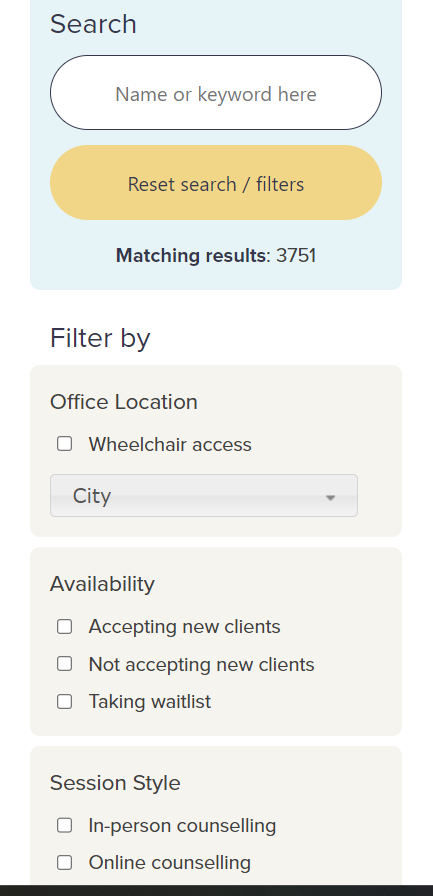
To help you find someone who is a good fit, I want to bring your attention to my college directory – BCACC, which stands for the BC Association of Clinical Counsellors. It’s a lovely website for counsellors registered in BC (the BC regulation body). It also has a really great updated find a counselor tool to help folks find a good fitting counselling. By using the filtering process, it can really help to narrow down your search in finding a good fitting counselor for you and your needs at this time. I’ve put a picture here as on the blog to give you a reference on what that will look like but just to go through it. It really is this wonderfully updated program that really helps to narrow down the search you can go off by whether or not you want to see someone online or in person, which community you want to see them in, and it also has a great new feature of folks who are currently not accepting clients, waitlisting clients, and actively accepting referrals. So when you’re looking for a counsellor I would really recommend choosing the actively looking actively accepting clients or the waitlisted options just because it will then weed out anybody who’s not currently taking on new clients.

It will help to really narrow down that the people that you are searching for are indeed able to take yours on their caseload in some capacity in now or in the upcoming months.

Another great option is if you have any funding in particular so if you’re coming through ICBC or First Nations Health Authority, or Crime Victim’s Assistance Program. There is a way to funnel through and also make the list smaller to be able to prioritize who accepts those services and those funding sources so that you’re not having to do the hard work of asking everybody you phone or e-mail trying to see if someone will take that funded session for you.

Once you’ve clicked and selected all the options that you’re interested in, and things that are important for you in your search, it will give you the candidates that are best suited for you, if that person exists in the request that you’re asking.

One thing that can happen is that the list can be zero options. If my list shows nothing, it might mean going back to the filters and noting anything there that you might be willing to compromise on or is there a different way of asking for what you need.

For example, sometimes you might be really particular about the specific issue you’re having and clinicians who could support you maybe noted the generalized version, instead of the specific topic (ie they might have chosen stress as a generic option but you’ve chosen workplace stress). Another option is also opening you search for anyone who’s also waitlisting clients as well. Waitlisting can be as short as a couple of weeks and as long as a few months, depending on the practitioner, so it’s really about allowing yourself that opportunity to have an option available if it OK that you wait a little bit in order to seek those services.

The last piece could be assessing whether you are willing to go virtual or outside of your community if your request was in person, or in town only. By broadening your location options, it can really be helpful to help you find a good fitting counsellor.

As always, I encourage everyone to shop around for counsellors- fill out their intake forms, take a look at their websites, and if they have any videos on there or social media platforms in which they share information. Take a look at them see if this is a person that you want to sit next with and you want to start talking about your personal experiences with. Your counsellor should be someone you feel safe with, or at least someone you are willing to create safety with; someone who seems knowledgeable enough for what you’re wanting.

Another piece that might be helpful in determining a good fit, is if they offer that free 15-minute consultation, then you can always contact them up and ask them for to schedule that or to look on their website and to see if you can schedule that yourself. That way you also get an opportunity to chat with them and see how you feel about working with them.

Folks too will offer on initial assessment option. Now this is a paid appointment, however when you talk with those clinicians if you decide it’s not a good fit or maybe they acknowledge that they’re not the best fit for you, that session it’s not a waste of time but a great piece of information gathering. That is because the clinician can then provide you with other resources or names of folks that might be better suited for you so you’re not walking away empty handed.

Once you have found somebody to make an appointment with, follow through on that and give yourself the opportunity to connect and get to working on the concerns that are bothering you.

Now I’ve said this before in previous posts, but if you’re in that appointment and it doesn’t feel comfortable, or you are not really feeling a connection with that person – don’t waste your time, and don’t waste your money (funding). Cultivating a really good relationship with your counsellor is very important because that’s going to be the foundation in which you’re going to get the most benefit and the most support no matter what other options you’re looking for in the therapeutic setting.

If you have any questions or if you’re looking for some referral sources you know I’m happy to support your journey and offer options to connect with!

…Stay tuned, and watch your emails as I have got some really awesome things in the works coming soon! I have a couple of freebies, courses, and handouts that I’ve put together and I’m just doing the back-end pieces to make them available.

This week was a lot

This week was a lot.

There were a lot of dates and information in the media this week. We have been made aware of annual dates of awareness and remembrance, possible changes in the legislation that could lead to devastating results, and really tough days to navigate. My hope in highlighting some of them that it will bring awareness to a lot of what has been on each of our minds this week and what you can do to help cope with the overload. 

Mental Health Awareness

It started off with the beginning of Mental Health Awareness month in the US, and Mental Health Awareness week in the US. A great campaign to bring forward the importance of taking care of our thoughts and emotions. 

MMIWG2S

Then the National Day of Awareness for Missing and Murdered Indigenous Women and Girls and Two-Spirit People (MMIWG2S). A day established because of Hanna Harris, a citizen of the Northern Cheyenne Tribe, who went missing on July 4, 2013 and was found dead three days later by volunteers. May 5 was chosen by the National Indigenous Women’s Resource Center (NIWRC) as it was Hanna Harris’ birthday. 

Roe v. Wade

And we can’t forget the devastating news coming from the US Supreme Court appearing poised to strike down Roe v. Wade, the legal case establishing the right to an abortion, resulting in a cascade of proposed restrictive abortion legislation.

Mother’s Day

And today is Mother’s Day in Canada. A day that can feel so great for those with mothers or who are mothers.

Mother’s day can be a source of great pain and difficulty however for:

  • Those who are longing to be moms
  • Those whose babies died during gestation
  • Those whose children have died
  • Those who do not have access to their children
  • Those who have strained relationships with their moms
  • Those who have strained relationships with their children
  • Those whose moms have died

Ongoing worldly concerns

All of this is of course on top of the ongoing wars and access restrictions, the ongoing discovery and count of unmarked graves at former Residential School sites, ongoing issues with access to clean drinking water on Indigenous lands, discrimination, inflation, a housing crisis, gas prices and oh yeah – the pandemic. 

How to cope

It’s A LOT! Maybe even more than you feel you are able to manage at the moment. 

So what can you do to cope?

Here are my top encouragements:

  1. Take a break from social media and news outlets. This can be incredibly helpful in the moment. Pausing your access to current events and information can reduce stress and feeling overwhelmed. Take as much time as you can (a day, a few days, a week, whatever works for you).
  2. Do whatever it is that soothes you. Self-care, self-care, self-care here folks! A bath, a walk outside, knitting/crochetting/quilting etc, arts and crafts, puzzles, a massage… the options are endless, and the benefits are tremendous.
  3. Connect with your supports. You are not meant to live this life alone, or to manage everything by yourself. Connect with those who make you feel good and who can support your need for a pause from current events.
  4. Reflect on where you live and focus on what impacts you directly (for now). It can be really helpful and important to reflect on where you live when hearing everything that is going on in the news. With modern technology it can feel like current events are happening directly to you when they aren’t. You can ask yourself: Where in the world am I right now? Is that happening in this country/city/etc right now? What do I need to do to stay safe?
  5. Create change or give back. Feel called to change what is happening around you or in the world? Take that motivation to make change and impact the lives of others for the better! Find places to volunteer, donate, or create a change you see is needed. 
  6. Have fun! You’ve heard me say this before – having fun is the easiest and quickest way to fill our cup of capabilities and resilience. It’s important that you have fun to fill your cup so that you can continue to make a difference in your life. 

If you are struggling at all with what is going on in the world, I hope this helps. And for those experiencing any difficulty with Mother’s Day, may you feel supported and connected as you navigate the day as best as you can.

Let’s stay connected!

If this is something that you are struggling with, and would like to work on it with a counsellor, visit the Contact Me link on my website to schedule an appointment today.

If you want more information, skills and support with your mental health, make sure to sign up for my email list to hear about my upcoming online Course in Mental Health!

Know someone who might benefit from reading this information? Feel free to share this with them, and encourage them to sign up for my blog emailed directly to them!

And don’t forget to follow me on Instagram or Facebook @devanceciliacounselling for daily supports and information!


photo cred: Road Trip with Raj

Pick Me Up!

Ever need a Pick Me Up?

Have you even needed a mental pick me up? A change of thoughts? Or a shift in mindset?

I know I have! And music has regularly been that supportive pick me up when I needed it.

When I had my first child I really wanted to create a set of songs that could do that for them. A playlist that they could play to remind them of their strengths, capabilities and help build their confidence; all while shifting negative thoughts and feelings that might be present.

Thich Nhat Hahn said “If you really know how to live, what better way to start
the day than with a smile? Smiling helps you approach the day with gentleness and understanding. Smile with your whole being.”

So we play this set of songs every morning because it makes us smile, it helps build skills, and it shift our moods.

*Happy bonus: not only does it help my kiddo, it helps me too!

Now, I’m not one to keep such helpful things to myself, so I’m sharing it with you all here!

Below is the list of songs currently on the playlist. I hope these songs help shift moods and builds skills for you!

Songs

Try everything – Shakira

How far ill go – Auli’i Cravalho

A Million Dreams – Ziv Zaifman, Hugh Jackman

Get Back Up Again – Anna Kendrick

Beautiful- Christina Aguilera

Never Ever Give Up – Matthew West

Born This Way – Lady Gaga

I AM WOMAN – Emmy Meli

Happy – Pharrell Williams

Cloudy Day – Tones and I

Brave – Sara Bareilles

Fight Song – Rachel Platten

This Is Me – Keala Settle

Mind My Business – Travis World

Live Your Story – Auli’i Cravalho

Got any songs that help you or your kiddos? If would love to know about them! Help me grow our playlist and pick me up songs! Feel free to send me an email and let me know what you’re listening to when you need a boost!

Let’s stay connected!

If this is something that you are struggling with, and would like to work on it with a counsellor, visit the Contact Me link on my website to schedule an appointment today.

If you want more information, skills and support with your mental health, make sure to sign up for my email list to hear about my upcoming online Course in Mental Health!

Know someone who might benefit from reading this information? Feel free to share this with them, and encourage them to sign up for my blog emailed directly to them!

And don’t forget to follow me on Instagram or Facebook @devanceciliacounselling for daily supports and information!

Photo cred: C D-X