Navigating Anxiety: Unlocking Effective Techniques and Approaches in Therapy

Anxiety can be a dreadful experience, impacting various aspects of our lives and well-being. For individuals facing the challenges with anxiety, whether it’s related to holidays, life transitions, grief, or other stressors, therapy offers a transformative journey toward effective coping strategies. In this blog post, let’s explore what anxiety therapy might look like, highlighting key techniques and approaches that can empower individuals on their path to mental wellness.

Understanding Anxiety:

Anxiety is a natural response in our bodies and is naturally intended to accompany stress. It tells us we need to pay attention to what is going on, and it is preparing us to be successful. But when it ventures away from stressful events and becomes persistent and overwhelming, it can significantly affect daily life. Recognizing the signs and seeking professional support is the first step toward managing anxiety effectively.

Techniques and Approaches in Anxiety Therapy:

  1. Cognitive-Behavioral Therapy (CBT):
    • What it is: CBT is a widely recognized therapeutic approach that focuses on identifying and challenging negative thought patterns and behaviors, which helps change emotional experiences.
    • How it helps: By addressing and changing distorted thinking and unhelpful behavioural patterns, individuals can develop healthier perspectives and coping mechanisms, reducing anxiety.
  2. Mindfulness and Relaxation Techniques:
    • What it is: Mindfulness involves staying present in the moment and cultivating awareness. Relaxation techniques, such as deep breathing or progressive muscle relaxation, can calm the nervous system.
    • How it helps: These practices promote a sense of calm, allow us to see beyond the immediate stressors, alleviate physical symptoms of anxiety, and enhance overall well-being.
  3. Exposure Therapy:
    • What it is: Exposure therapy involves gradually facing feared situations in a controlled and supportive environment to reduce anxiety.
    • How it helps: By confronting fears systematically, individuals can build resilience and decrease the intensity of anxious responses.
  4. Acceptance and Commitment Therapy (ACT):
    • What it is: ACT encourages acceptance of distressing thoughts and feelings while committing to actions aligned with one’s values.
    • How it helps: This approach fosters a mindful and values-driven life, reducing the impact of anxiety on decision-making and overall functioning.
  5. Eye Movement Desensitization and Reprocessing (EMDR):
    • What it is: EMDR is a therapeutic approach specifically designed to address trauma and distressing memories.
    • How it helps: By reprocessing traumatic memories, individuals can alleviate associated anxiety and develop more adaptive responses.
  6. Positive Psychology Interventions:
    • What it is: Positive psychology interventions focus on building strengths, fostering gratitude, and enhancing positive emotions.
    • How it helps: By shifting the focus to positive aspects of life, individuals can counterbalance negative thought patterns and reduce anxiety.

How Therapy Supports the Journey:

  1. Individualized Strategies: Therapy provides a tailored approach, identifying specific anxiety triggers and developing personalized strategies for each individual.
  2. Safe Space for Exploration: A clinical counsellor offers a safe and non-judgmental space for individuals to explore the root causes of anxiety and work towards a resolution.
  3. Skill-Building: Therapy equips individuals with practical skills to manage anxiety in real-life situations, empowering them to face challenges with resilience.
  4. Long-Term Resilience: By addressing the underlying causes of anxiety, therapy aims to foster long-term resilience, providing individuals with tools to navigate future stressors.

In conclusion, anxiety therapy is a collaborative journey that combines evidence-based techniques with individualized approaches. Whether it’s through CBT, mindfulness, or other therapeutic modalities, individuals can cultivate effective strategies to manage anxiety and reclaim a sense of balance and well-being. If anxiety is impacting your life, taking the step towards therapy can be a transformative investment in your mental health.

Strategies for Stress: Manage and Prevent Burnout

scrabble letters read inhale exhale repeat

In the fast-paced world we live in, stress has become an inevitable part of daily life. For many individuals, managing and preventing burnout is a constant challenge. Whether you’re juggling work, family, or personal responsibilities, seeking strategies for stress offers valuable strategies to navigate your needs and foster resilience. Here are some practical, easy-to-implement strategies that can be transformative tools for individuals seeking to manage and prevent burnout.

Understanding Stress Management:

Stress management, and stress therapy, are specialized forms of support designed to help individuals navigate the complexities of stress, prevent burnout, and build resilience. They encompass a range of counselling therapeutic approaches and practical strategies aimed at addressing the physical, emotional, and cognitive aspects of stress.

Key Components of Stress Management:

  1. Identifying Stress Triggers:
    • Stress management begins with identifying the specific triggers that contribute to heightened stress levels. This may include work pressures, relationship challenges, or lifestyle factors. Understanding these triggers is a crucial step toward effective stress management because when we can identify them, we can look to see what we can do about them.
  2. Cognitive-Behavioral Techniques:
    • Cognitive-behavioral therapy (CBT) can be a very common component of stress management. It focuses on identifying and challenging negative thought patterns and behaviors associated with the stress we are experiencing. Research shows that how we look and think about stress impacts how we will handle it, our health, and even the length of our lifespan. By reshaping our thinking patterns to see stress as helpful, individuals can view stress differently, develop healthier responses to stressors, and actually live longer lives!
  3. Mindfulness and Relaxation Techniques:
    •  When engaging in stress management, or attending stress therapy, it often incorporates mindfulness and relaxation techniques to promote a sense of calm and centeredness. Practices such as deep breathing, focusing, and progressive muscle relaxation can be powerful tools in reducing how you feel stress, while also creating space to understand what you need to do about it.
  4. Time Management and Boundaries:
    • Effective time management and setting healthy boundaries are essential components of stress management. Learning to prioritize tasks, delegate responsibilities, and establish boundaries in both personal and professional life contributes to a more balanced and manageable lifestyle. Think about it this way- saying no in one direction in your life, can allow you to say yes in others.
  5. Emotional Expression and Support:
    • A strongly encouraged part of Stress therapy focuses on creating a safe space for individuals to express their emotions openly. Talking about stressors and receiving empathetic support from a therapist can alleviate emotional burdens and foster a sense of connection.
    • Interestingly enough, research also shows that if you help others, it can be a big contributing factor to how you feel and are impacted by stress. It can be as simple as opening doors, helping someone out with something they need, making check in calls, or spending meaningful moments with others. It can be with people in your life already, or extending support to others in your community.

Practical Strategies for Stress:

  1. Prioritize Self-Care:
    • Engaging in regular self-care activities, such as exercise, adequate sleep, and fun, is fundamental in stress management. Prioritizing self-care nurtures physical and emotional well-being, creating a buffer against the impact of stress.
  2. Establish Healthy Routines:
    • Creating and maintaining healthy daily routines can provide a sense of structure and predictability. Consistent routines contribute to a stable foundation, making it easier to navigate stressors with resilience.
  3. Set Realistic Goals:
    • Stress therapy involves setting realistic and achievable goals. Breaking down larger tasks into smaller, manageable steps fosters a sense of accomplishment and reduces the overwhelming nature of stressors.
  4. Seek Social Support:
    • Building a supportive network is a valuable aspect of stress management. Connecting with friends, family, or support groups provides opportunities for shared experiences and emotional support. Remember how important it is to help others? This can also be applied to yourself in accepting help from others where needed.
  5. Develop Coping Strategies:
    • Stress therapy equips individuals with personalized coping strategies. This may include positive affirmations, visualization, or developing a toolbox of techniques to turn to during challenging moments.

Preventing Burnout:

  1. Regular Check-Ins:
    • Stress therapy encourages regular check-ins with oneself to assess stress levels. Being proactive in recognizing signs of burnout allows for timely intervention and adjustment of stress management strategies.
  2. Boundaries and Work-Life Balance:
    • Establishing clear boundaries between work and personal life is vital in preventing burnout. Stress therapy explores effective strategies for maintaining a healthy work-life balance and avoiding the pitfalls of constant overcommitment.
  3. Mindful Rest and Recovery:
    • Incorporating mindful rest and recovery into daily life is essential for preventing burnout. This may involve taking breaks, engaging in hobbies, or simply allowing oneself moments of quiet reflection. Quick tip: a minful rest can be small moments throughout your day – a deep breathe here and there can make a huge difference in how you feel, without taking significant time in your already very busy day.

Getting Started with Stress Therapy:

  1. Recognize the Need for Support:
    • Acknowledge the importance of seeking support for stress management. Recognizing the need for stress therapy is a proactive step toward preventing burnout and fostering resilience.
  2. Research and Choose a Suitable Therapist:
    • Research therapists specializing in stress management and choose someone with experience in addressing the specific stressors you wish to explore. Look for therapists who provide a supportive and non-judgmental environment, and who you feel comfortable being honest and open with.
  3. Schedule an Initial Consultation:
    • Many stress therapists offer initial consultations to discuss your goals, concerns, and the therapeutic process. This meeting allows you to assess whether the therapist’s approach resonates with your needs and comfort level.
  4. Commit to the Process:
    • Committing to the stress therapy process is essential for meaningful progress. Consistency and openness to exploration contribute to the effectiveness of stress therapy in managing and preventing burnout.

Conclusion:

Stress management and stress therapy stand as transformative tools for individuals seeking to manage and prevent burnout in the face of life’s challenges. By identifying stress triggers, incorporating practical strategies, and fostering a proactive approach to well-being, they empower individuals to navigate the tornado of stress with resilience and a renewed sense of balance. If you’re on a journey toward stress management and burnout prevention, consider the possibilities that stress therapy may offer in cultivating a more sustainable and fulfilling life.

Navigating the Digital Overload: Protecting Your Mental Health from Social Media News Flooding

photo of someone with a laptop opened and facebook noted on the screen, while also holding a cellphone to the side with another social media program open

Protecting Your Mental Health from Social Media News Flooding

In our digital age, and in the current world events media, the constant stream of news on social media has become an inescapable aspect of daily life. While staying informed can be crucial, the relentless accessibility and visual impact of news can take a toll on our mental well-being. Especially when the images and videos pop up on our feed without warning or invitation. For individuals seeking to protect their mental health, especially those feeling overwhelmed, overexposed, and struggling with what they are seeing, understanding the potential trauma induced by social media news exposure and adopting mindful practices is paramount.

The Digital Overload: Unveiling the Impact of Social Media News

In the pursuit of staying informed, social media apps expose us to a barrage of news, often accompanied by distressing visuals. For those of us living in British Columbia, where the natural beauty is a stark contrast to the sometimes harsh realities portrayed in the news, this constant influx can trigger feelings of overwhelm, anxiety, and even create vicarious trauma (which is when we have a negative response to being exposed to others’ trauma). The visual nature of social media news intensifies our emotional responses, leaving us grappling with the aftermath of what we’ve seen.

Understanding Trauma in the Digital Age:

  1. Visual Overload:
    • The visual nature of news on social media amplifies its emotional impact. Graphic images and videos can evoke immediate and intense emotional reactions, potentially leading to vicarious trauma.
  2. Constant Accessibility:
    • The 24/7 accessibility of news on social media means there’s no respite from distressing information. The constant exposure can lead to a state of hyperarousal, where individuals are always on edge, anticipating the next distressing piece of news.
  3. News Fatigue:
    • The sheer volume of news can result in news fatigue, where individuals feel emotionally drained and desensitized to the suffering portrayed. This fatigue can contribute to a sense of helplessness and disconnection from one’s own emotions.

How to Safeguard your Mental Health: Strategies for Support

  1. Mindful Consumption:
    • Be intentional about the news you consume. Choose reliable sources and set limits on your daily news intake. This can look like setting a timer on or outside of your devices, or adding apps to your devices that can interrupt your scrolling and help you pause and decide if you want to keep scrolling. These practices can create a sense of control over the information they expose themselves to.
  2. Scheduled News Breaks:
    • Designate specific times for news consumption rather than allowing it to infiltrate your day constantly. Creating boundaries around when and how you engage with news on social media helps in preventing emotional overwhelm. This might look like delaying when you open the apps on your devices until later in the day, or closing your devices for good an hour or more before bedtime.
  3. Balance with Positive Content:
    • Counterbalance distressing news with uplifting and positive content. Follow accounts that share inspiring stories, nature visuals, or content related to your personal interests. This balance can help restore a sense of equilibrium.
  4. Digital Detox:
    • Periodically disconnect from social media altogether. A digital detox allows time for mental recalibration, reducing the risk of news-induced trauma. This could involve spending time in the serene outdoors or engaging in activities or hobbies that bring joy and peace, like reading books, colouring, going for walks, listening to music, or learning something new.
  5. Mindful Awareness of Triggers:
    • Pay attention to your emotional responses when exposed to news on social media. Identify specific triggers that evoke distress and consider muting or unfollowing accounts that consistently produce content that adversely affects your mental health.
  6. Seek Support:
    • Share your feelings with trusted friends, family, or professionals. Engaging in open conversations about the impact of news exposure fosters a sense of connection and understanding.
  7. Do Something to Create Change
    1. If what you are consuming has you feeling hopeless, helpless, overwhelmed, angry, scared, frustrated, or fearful, it can be a sign that what is happening does not align with you and your values. Something that you can do to help yourself feel like you have some control over what is happening, is to do something about it that contributes to change. Sign a petition, go to a rally, or donate to registered, reputable organizations that are sending support to those in need. While you might not feel like your one contribution will make a difference, if many people make one small difference, a lot can change.

Cultivating Digital Well-being: A Personal Journey

  1. Reflect on Your Values:
    • Take time to reflect on your personal values and how they align with your digital habits. Consider what kind of information resonates with your beliefs and contributes positively to your well-being.
  2. Set Clear Intentions:
    • Establish clear intentions for your social media use. Define the purpose it serves in your life and be intentional about the content you engage with. This could involve using social media as a tool for connection and community engagement.
  3. Connect with Nature:
    • Embrace the natural beauty of British Columbia (or where ever you live) as a counterbalance to digital exposure. Spend time outdoors, engage in activities that connect you with nature, and allow the serene landscapes to serve as a source of solace and rejuvenation.
  4. Practice Gratitude:
    • Cultivate a practice of gratitude to shift your focus towards positive aspects of life. Whether it’s acknowledging the beauty around you or expressing gratitude for small moments, this practice enhances your overall well-being.
  5. Digital Mindfulness Techniques:
    • Incorporate mindfulness techniques into your digital routine. Practice deep breathing, meditation, or mindfulness exercises to center yourself and build resilience against the potential vicarious trauma exposure by distressing news.

Conclusion: Navigating the Digital Landscape Mindfully

In the age of digital connectivity, protecting our mental health from the potential vicarious trauma induced by social media news exposure requires intentional and mindful practices. For BC residents, the contrast between the digital deluge and the natural beauty of their surroundings emphasizes the importance of finding balance. By cultivating digital well-being, setting clear intentions, and embracing mindful practices, individuals can navigate the digital landscape with resilience and safeguard their mental health amidst the constant stream of news on social media.

Online Courses Now Available!

person jumping in excitement in the air in front of the sunset. Some trees and hills noticed.

Online Courses Now Available!

EEEEEKKKK Folks! I am sooo excited to share with you that my online courses are now available for purchase!

While they aren’t all available just yet, three of the most commonly talked about concerns in my practice are.!

I am very excited to share that the Mini Crash Course in Anxiety, Stress, and Anger are all available immediately!

For those of you who have been following along, these Crash Courses in Anxiety, Stress, and Anger, are part of the Crash Course in Mental Wellness Series that I have been working on over the past couple of years.

I was called to create these courses for a handful of reasons:

  1. When I am working, I commonly see folks accessing counselling services through their extended health benefits or out of pocket payments, and sessions were limited; therefore limiting their opportunities to get to the route causes of their concerns and only getting the band-aid tools to help manage in the moment. I wanted to be able to offer something to folks that helped them get more for their money and time.
  2. I was on (my first) maternity leave and knew the clients who wanted to wait for me to come back deserved something to support themselves while I was away.
  3. When I came back to work, I still had people waitlisted for services and I hated that they were waiting to get support because I didn’t have the space to bring them in when they needed it.
  4. I am again on (my last) maternity leave and I continue to get requests from new clients asking for support, but I cannot accommodate them at this time as I am not yet back to work, and continue to hold a waitlist for services.

Please hear me when I say I HATE it that I cannot offer services at this time for folks asking for it. It takes immense courage to recognize the needs for support and I went in to this field to be that person people could turn to in times of need.

So to help balance these needs, I plugged into my computer while my littles slept, to create an option where I could share the top skills and information I use and teach to folks in need of help right now.

In each of these courses, I offer you some of the most commonly used skills I share with clients to help them with their anxiety, and I hope that they are helpful for you too!

Each course is geared to help folks at any time of day, from the comfort of your own home, with quick skills that can change your experience immediately, even if just a bit to get you through.

Each course comes with at least a handful of skills, sold for less than the cost of one counselling session, and will take about an hour of your time to get through.

So if you, or someone you know is looking for mental health support and would like to create a foundation of skills before or along side engaging in counselling, check out this, and the upcoming, courses that will be available!

And of course, I would be ever so grateful if you wanted to share the announcement of these courses with your friends and family!

As always, I would love to hear your thoughts and feedback, and would deeply appreciate it if you chose to share these options with others who might need the support too. Feel free to devanceciliacounselling@gmail.com

It’s Almost Here!

computer screen reads 'learn at your own pace crash course to mental wellness series with DevanCecilia Counselling read and practice from the comfort of your home visit www.devanceciliacounselling.com'

It’s almost here! It’s almost here!

I am incredibly excited to share with you some long awaited big news: the Crash Course to Mental Wellness Series is almost here!

After going back to work put a year-long delay in launching – the time has finally come back around, and this time it’s better! It’s better because it is redesigned to serve you for your specific needs!

This offering now comes as a mini series of 6 different topics to support your mental wellness- anger, anxiety, stress, depression, mindfulness, and grief.

Want to learn more about it?

Originally designed as one big course, I recognized that not everyone needs or wants all of the information. You, for example, might be interested in one or two of the topics but not all of it. So why would I overwhelm you with a bunch of information you didn’t want?

Instead, I have redesigned the information to be shared in 6 different mini courses. All online, all go at your own pace, and all set up in an easy to read, easy to learn and practice way.

In this series I share my most favourite skills to practice myself, and with my one-to-one clients.

Think if it as a series of counselling sessions at the comfort and leisure of your own pace and time – no need to have a scheduled appointment! You can do this whenever it suits you best.

If you would like to get on the email list to be notified when the courses go live – sign up here! I can’t wait to share this information with you!

I’ve had quite the year running my counselling business…

Devan standing holding pregnant belly

Hello everyone!

I’ve had quite the year running my counselling business…and it’s been some time since I last connected – I apologize for that! A lot has been going on!

For those of you who might not follow me on social media, I have had quite the year.

When I was posting more frequently to you previously, I was on my first maternity leave, and had some time to play catch up on sharing the information I have in my head to those who are interested 😊

However, as I geared up to go back to work, I changed some programming for my business and then hit the ground running – back to work full time with an agency, and working in my business in the evenings again – only this time with a toddler.

As much as I was working to balance it and keep this going – wouldn’t you know it, we were blessed with another pregnancy! That also mean less energy and time for me – so my blog writing was the piece that took the first pause.

Now that I am on my second  (and final!) maternity leave, I am so thrilled to be back here, sharing information with you about topics and I am passionate about.

One topic I really want to bring forward was how actually to find a counsellor. I am redirecting folks weekly on how to find a counsellor, and hope that this bit of information might be helpful for anyone in BC looking for some help.

When looking for a counsellor, there are a few ways to go about it.

  1. Google – you type in something like ‘counsellor Chilliwack’ and see a whole list of folks who practice in Chilliwack – yahoo! You’ve started with a list. However, now you have to go through all of their websites to see if they work with the concerns that are bringing you to counselling. This is a lot of time, and might be even more of your time if you reach out to them and they share that they are currently not taking on new clients.
  2. Word of mouth – now while this is an excellent way to find a counsellor (as they come vetted by someone you most likely trust) – however they too might not work with the concerns that bring you to counselling, or taking on new clients, or even so they might not be able to take you on because of a conflict of interest with the person who referred you (not always but it happens).
  3. Look someone up from a directory – this can be a bit of work as you also have to read through websites/profiles and contact them to connect. HOWEVER, directories also have a space where the therapist can note if they are currently accepting clients, waitlisting clients, or not accepting clients. This aspect alone can save you quite a bit of time and browsing just by ruling out who cannot help you at this time.

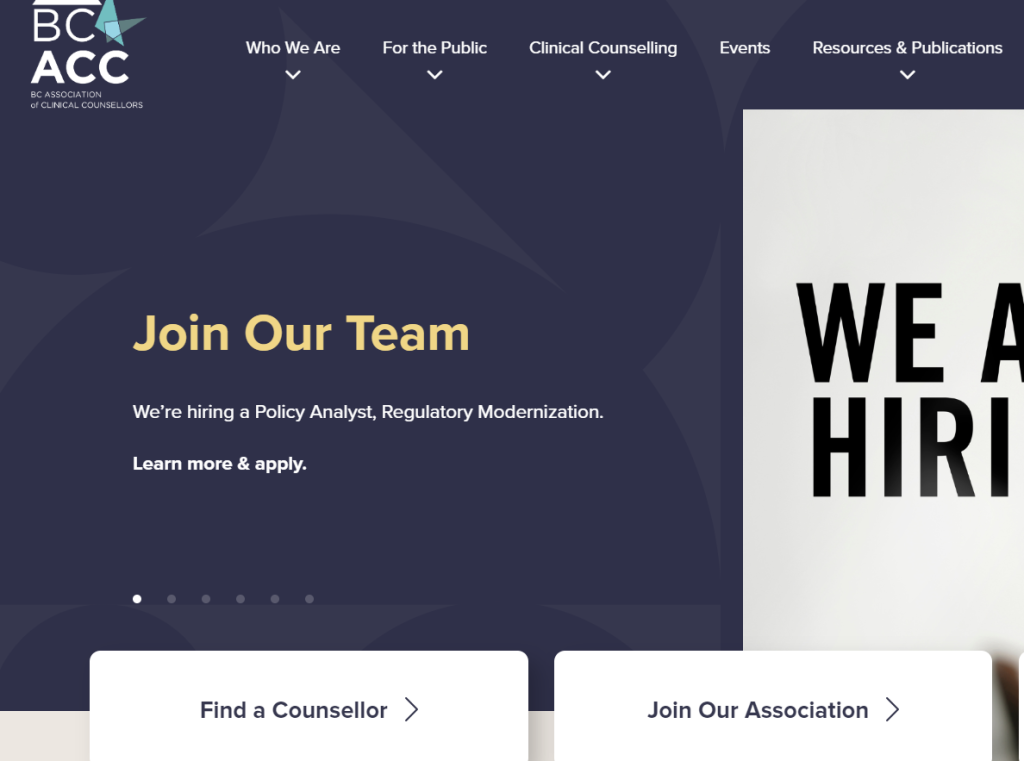
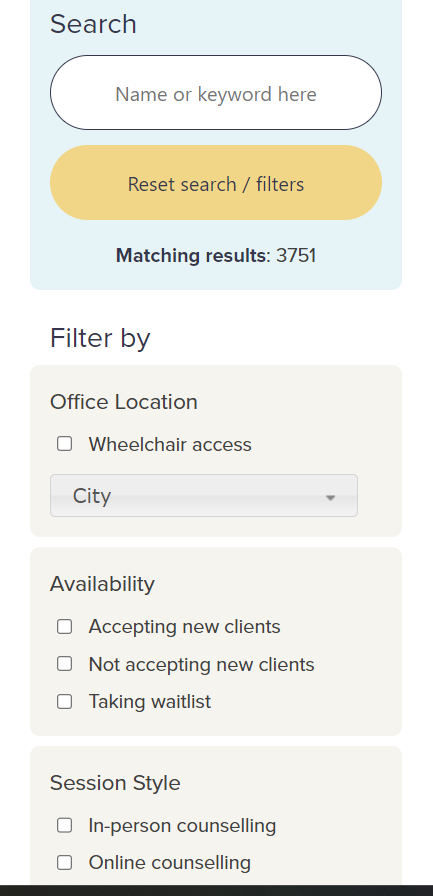
To help you find someone who is a good fit, I want to bring your attention to my college directory – BCACC, which stands for the BC Association of Clinical Counsellors. It’s a lovely website for counsellors registered in BC (the BC regulation body). It also has a really great updated find a counselor tool to help folks find a good fitting counselling. By using the filtering process, it can really help to narrow down your search in finding a good fitting counselor for you and your needs at this time. I’ve put a picture here as on the blog to give you a reference on what that will look like but just to go through it. It really is this wonderfully updated program that really helps to narrow down the search you can go off by whether or not you want to see someone online or in person, which community you want to see them in, and it also has a great new feature of folks who are currently not accepting clients, waitlisting clients, and actively accepting referrals. So when you’re looking for a counsellor I would really recommend choosing the actively looking actively accepting clients or the waitlisted options just because it will then weed out anybody who’s not currently taking on new clients.

It will help to really narrow down that the people that you are searching for are indeed able to take yours on their caseload in some capacity in now or in the upcoming months.

Another great option is if you have any funding in particular so if you’re coming through ICBC or First Nations Health Authority, or Crime Victim’s Assistance Program. There is a way to funnel through and also make the list smaller to be able to prioritize who accepts those services and those funding sources so that you’re not having to do the hard work of asking everybody you phone or e-mail trying to see if someone will take that funded session for you.

Once you’ve clicked and selected all the options that you’re interested in, and things that are important for you in your search, it will give you the candidates that are best suited for you, if that person exists in the request that you’re asking.

One thing that can happen is that the list can be zero options. If my list shows nothing, it might mean going back to the filters and noting anything there that you might be willing to compromise on or is there a different way of asking for what you need.

For example, sometimes you might be really particular about the specific issue you’re having and clinicians who could support you maybe noted the generalized version, instead of the specific topic (ie they might have chosen stress as a generic option but you’ve chosen workplace stress). Another option is also opening you search for anyone who’s also waitlisting clients as well. Waitlisting can be as short as a couple of weeks and as long as a few months, depending on the practitioner, so it’s really about allowing yourself that opportunity to have an option available if it OK that you wait a little bit in order to seek those services.

The last piece could be assessing whether you are willing to go virtual or outside of your community if your request was in person, or in town only. By broadening your location options, it can really be helpful to help you find a good fitting counsellor.

As always, I encourage everyone to shop around for counsellors- fill out their intake forms, take a look at their websites, and if they have any videos on there or social media platforms in which they share information. Take a look at them see if this is a person that you want to sit next with and you want to start talking about your personal experiences with. Your counsellor should be someone you feel safe with, or at least someone you are willing to create safety with; someone who seems knowledgeable enough for what you’re wanting.

Another piece that might be helpful in determining a good fit, is if they offer that free 15-minute consultation, then you can always contact them up and ask them for to schedule that or to look on their website and to see if you can schedule that yourself. That way you also get an opportunity to chat with them and see how you feel about working with them.

Folks too will offer on initial assessment option. Now this is a paid appointment, however when you talk with those clinicians if you decide it’s not a good fit or maybe they acknowledge that they’re not the best fit for you, that session it’s not a waste of time but a great piece of information gathering. That is because the clinician can then provide you with other resources or names of folks that might be better suited for you so you’re not walking away empty handed.

Once you have found somebody to make an appointment with, follow through on that and give yourself the opportunity to connect and get to working on the concerns that are bothering you.

Now I’ve said this before in previous posts, but if you’re in that appointment and it doesn’t feel comfortable, or you are not really feeling a connection with that person – don’t waste your time, and don’t waste your money (funding). Cultivating a really good relationship with your counsellor is very important because that’s going to be the foundation in which you’re going to get the most benefit and the most support no matter what other options you’re looking for in the therapeutic setting.

If you have any questions or if you’re looking for some referral sources you know I’m happy to support your journey and offer options to connect with!

…Stay tuned, and watch your emails as I have got some really awesome things in the works coming soon! I have a couple of freebies, courses, and handouts that I’ve put together and I’m just doing the back-end pieces to make them available.

This week was a lot

This week was a lot.

There were a lot of dates and information in the media this week. We have been made aware of annual dates of awareness and remembrance, possible changes in the legislation that could lead to devastating results, and really tough days to navigate. My hope in highlighting some of them that it will bring awareness to a lot of what has been on each of our minds this week and what you can do to help cope with the overload. 

Mental Health Awareness

It started off with the beginning of Mental Health Awareness month in the US, and Mental Health Awareness week in the US. A great campaign to bring forward the importance of taking care of our thoughts and emotions. 

MMIWG2S

Then the National Day of Awareness for Missing and Murdered Indigenous Women and Girls and Two-Spirit People (MMIWG2S). A day established because of Hanna Harris, a citizen of the Northern Cheyenne Tribe, who went missing on July 4, 2013 and was found dead three days later by volunteers. May 5 was chosen by the National Indigenous Women’s Resource Center (NIWRC) as it was Hanna Harris’ birthday. 

Roe v. Wade

And we can’t forget the devastating news coming from the US Supreme Court appearing poised to strike down Roe v. Wade, the legal case establishing the right to an abortion, resulting in a cascade of proposed restrictive abortion legislation.

Mother’s Day

And today is Mother’s Day in Canada. A day that can feel so great for those with mothers or who are mothers.

Mother’s day can be a source of great pain and difficulty however for:

  • Those who are longing to be moms
  • Those whose babies died during gestation
  • Those whose children have died
  • Those who do not have access to their children
  • Those who have strained relationships with their moms
  • Those who have strained relationships with their children
  • Those whose moms have died

Ongoing worldly concerns

All of this is of course on top of the ongoing wars and access restrictions, the ongoing discovery and count of unmarked graves at former Residential School sites, ongoing issues with access to clean drinking water on Indigenous lands, discrimination, inflation, a housing crisis, gas prices and oh yeah – the pandemic. 

How to cope

It’s A LOT! Maybe even more than you feel you are able to manage at the moment. 

So what can you do to cope?

Here are my top encouragements:

  1. Take a break from social media and news outlets. This can be incredibly helpful in the moment. Pausing your access to current events and information can reduce stress and feeling overwhelmed. Take as much time as you can (a day, a few days, a week, whatever works for you).
  2. Do whatever it is that soothes you. Self-care, self-care, self-care here folks! A bath, a walk outside, knitting/crochetting/quilting etc, arts and crafts, puzzles, a massage… the options are endless, and the benefits are tremendous.
  3. Connect with your supports. You are not meant to live this life alone, or to manage everything by yourself. Connect with those who make you feel good and who can support your need for a pause from current events.
  4. Reflect on where you live and focus on what impacts you directly (for now). It can be really helpful and important to reflect on where you live when hearing everything that is going on in the news. With modern technology it can feel like current events are happening directly to you when they aren’t. You can ask yourself: Where in the world am I right now? Is that happening in this country/city/etc right now? What do I need to do to stay safe?
  5. Create change or give back. Feel called to change what is happening around you or in the world? Take that motivation to make change and impact the lives of others for the better! Find places to volunteer, donate, or create a change you see is needed. 
  6. Have fun! You’ve heard me say this before – having fun is the easiest and quickest way to fill our cup of capabilities and resilience. It’s important that you have fun to fill your cup so that you can continue to make a difference in your life. 

If you are struggling at all with what is going on in the world, I hope this helps. And for those experiencing any difficulty with Mother’s Day, may you feel supported and connected as you navigate the day as best as you can.

Let’s stay connected!

If this is something that you are struggling with, and would like to work on it with a counsellor, visit the Contact Me link on my website to schedule an appointment today.

If you want more information, skills and support with your mental health, make sure to sign up for my email list to hear about my upcoming online Course in Mental Health!

Know someone who might benefit from reading this information? Feel free to share this with them, and encourage them to sign up for my blog emailed directly to them!

And don’t forget to follow me on Instagram or Facebook @devanceciliacounselling for daily supports and information!


photo cred: Road Trip with Raj

What Is The Difference Between Burnout and Stress?

What Is The Difference Between Burnout and Stress?

Have you ever asked yourself this question?

For most folks, you probably haven’t – and that’s a great thing to realize! It means that you most likely have never been in a place where you needed to know the difference. 

For the rest of us though – it was most likely learned….

How?

-You’ve realized it after you came out of burnout

-You were told you were burnt out by someone in your life (a professional or other person)

-Maybe you googled your symptoms 

-You watched someone you love experience it

-You are going through it right now and are looking for help

No matter how you have come to learn about burnout, chances are, you might benefit from knowing a bit more about it, and what to do about it. Plus, it is always helpful to know how it looks different from stress, so that you can support yourself if you end up heading toward burnout again.

So what is Burnout?

The World Health Organization defines Burnout as:

a syndrome conceptualized as resulting from chronic workplace stress that has not been successfully managed. It is characterized by three dimensions:

  • feelings of energy depletion or exhaustion;
  • increased mental distance from one’s job, or feelings of negativism or cynicism related to one’s job; and
  • reduced professional efficacy

Now workplace is anywhere you are conducting work:

-Caregiving

-Parenting

-Self-employment

-Student

-Employee

Burnout is the place we can get to when the stress level in our job is too high, for too long, and we can no longer sustain the capacity at which we were working. 

So how is Burnout different from Stress?

Burnout and stress can look and feel very similar, so it’s natural that there might be confusion on how they are different.

Stress is defined by the National Institute of Mental Health as:

    • A response to an external cause, such as taking a big test or arguing with a friend.
    • Goes away once the situation is resolved.
  • Can be positive or negative. For example, it may inspire you to meet a deadline, or it may cause you to lose sleep.
  • You may experience symptoms such as:
    • Excessive worry
    • Uneasiness
    • Tension
    • Headaches or body pain
    • High blood pressure
    • Loss of sleep

Stress is a natural response our body has in response to a threat. It is helpful to motivate us to move, and keeps us safe.

What isn’t helpful, is when we are experiencing a lot of stress over a long period of time, without any real  break or reprieve. We may not even know when the expectations of the job will be over, and it may seem as though there is no immediate ‘end in sight’. 

So this is where you might find yourself mentally ‘checking out’ for longer periods of time. You might feel constantly exhausted, with no amount of sleep making it better. You might be making more mistakes, or forgetting important things. It may be that you even start to think or speak negatively about the role you are fulfilling. 

Burnout is a lot. And it needs a lot of change to get better.

Ok, so what can I do about it?

Step 1:

As with all mental health, the first step is learning to recognize the signs. Are you experiencing any of the symptoms mentioned above? 

Step 2:

Once you can name the concerns you are having, now you need to figure out the source. This might seem like a no-brainer, but naming the source and admitted to yourself (and others) what is causing burnout, means you can start problem solving the issues. Because burnout is not something that is wrong with you- it is something that is happening to you. 

Step 3:

Start to figure out what can be changed immediately. The importance here is to figure out what are some quick and even small steps you can take to change what is happening for you. For example, giving tasks back to others instead of trying to do everything yourself. Will it be done to your standard? Maybe not, but if it can still get done, then it is one less thing you have to try to squeeze in your limited time.

Step 4:

Talk to your supports. Share your concerns and struggles with those who are supportive. Utilize these folks to help brain storm other ways you can get support and share the load of what you are trying to manage. *Talking to a counsellor is very helpful here as they are not involved in the current situation bringing on your burnout.

Step 5:

Look at your options. Do you have to keep doing this role? Can you change something about it? Is there a time limit you can see and work within?

Step 6:

Set boundaries with yourself and others. Do what you can and have agreed to do, hold firm (even to yourself) on not taking on more. Delegate other needs to folks or services available. You may even need to prioritize tasks and leave what is not a priority.

Step 7:

Prioritize your well-being. This means giving yourself compassion for what you are going through, have gone through, and are about to go through. It means committing to self-care: move your body daily, spend time with your favourite people or animals, go to bed early without finishing all the chores in the house, get back to your hobbies, and at the bare minimum – take the time you need to get your basic needs accomplished. And, if you want to fill your cup up the fastest: do fun things! Whatever it is that makes you smile or laugh or simply enjoy doing – do as many of those as you want.

Take home message:

Burnout is stress that has been pushed too far. And the way to get better: is to let go of what you can and add as much fun as possible back into your life as soon as possible. 

Need help with this? Head over the to Contact Me page and let’s get started!


LET’S STAY CONNECTED!

If this is something that you are struggling with, and would like to work on it with a counsellor, visit the Contact Me link on my website to schedule an appointment today.

If you want more information, skills and support with your mental health, make sure to sign up for my email list to hear about my upcoming online Course in Mental Health!

Know someone who might benefit from reading this information? Feel free to share this with them, and encourage them to sign up for my blog emailed directly to them!

And don’t forget to follow me on Instagram or Facebook @devanceciliacounselling for daily supports and information!


photo cred: Naomi August 


Pick Me Up!

Ever need a Pick Me Up?

Have you even needed a mental pick me up? A change of thoughts? Or a shift in mindset?

I know I have! And music has regularly been that supportive pick me up when I needed it.

When I had my first child I really wanted to create a set of songs that could do that for them. A playlist that they could play to remind them of their strengths, capabilities and help build their confidence; all while shifting negative thoughts and feelings that might be present.

Thich Nhat Hahn said “If you really know how to live, what better way to start
the day than with a smile? Smiling helps you approach the day with gentleness and understanding. Smile with your whole being.”

So we play this set of songs every morning because it makes us smile, it helps build skills, and it shift our moods.

*Happy bonus: not only does it help my kiddo, it helps me too!

Now, I’m not one to keep such helpful things to myself, so I’m sharing it with you all here!

Below is the list of songs currently on the playlist. I hope these songs help shift moods and builds skills for you!

Songs

Try everything – Shakira

How far ill go – Auli’i Cravalho

A Million Dreams – Ziv Zaifman, Hugh Jackman

Get Back Up Again – Anna Kendrick

Beautiful- Christina Aguilera

Never Ever Give Up – Matthew West

Born This Way – Lady Gaga

I AM WOMAN – Emmy Meli

Happy – Pharrell Williams

Cloudy Day – Tones and I

Brave – Sara Bareilles

Fight Song – Rachel Platten

This Is Me – Keala Settle

Mind My Business – Travis World

Live Your Story – Auli’i Cravalho

Got any songs that help you or your kiddos? If would love to know about them! Help me grow our playlist and pick me up songs! Feel free to send me an email and let me know what you’re listening to when you need a boost!

Let’s stay connected!

If this is something that you are struggling with, and would like to work on it with a counsellor, visit the Contact Me link on my website to schedule an appointment today.

If you want more information, skills and support with your mental health, make sure to sign up for my email list to hear about my upcoming online Course in Mental Health!

Know someone who might benefit from reading this information? Feel free to share this with them, and encourage them to sign up for my blog emailed directly to them!

And don’t forget to follow me on Instagram or Facebook @devanceciliacounselling for daily supports and information!

Photo cred: C D-X

How Do I Get Rid of Anxiety?

HOW DO I GET RID OF ANXIETY? PART SIX:

Here’s the last of it folks!  Part Six of our How Do I Get Rid of Anxiety blog series.

I had to save the best skill for last, right?

Progressive muscle relaxation

Progressive muscle relaxation is one of the most successful tools I can offer you (after breathing). It is one that you can adapt and do anywhere, anytime. While it is most helpful and encouraged to be used when you are about to go to sleep (great sleep hygiene tool!), it can be incredibly helpful for anger. Progressive muscle relaxation is used to purposely build tension in specific muscle groups and to rapidly release that tension. The purpose of that rapid release is to highly to your body the change in experience, and to help release any tension that was there prior to engaging in the activity. So ultimately, you are releasing the tension you were experiencing by purposefully creating more tension and teaching your body how to let it go.

Bonus: it is the only mindfulness exercise that encourages you to allow yourself to fall asleep during the process – it means you really became relaxed!

Now when engaging in progressive muscle relaxation it is imperative that you do not cause physical strain or injury to any area that you are focusing on. And, if you have an area of your body that is already injured, you want to avoid physically adding more strain to that area. So, you can omit the area completely, or you can imagine what it would feel like to create tension in that area, and imagine what it would feel like as you quickly released it. Even though you would be imagining this added and released tension, it can still have an effect on that area, and can release some of the tension that you are indeed carrying in that area.

It is really important to remember to keep breathing throughout this exercise. If you notice that you are holding your breath, just notice it and invite yourself to start breathing again during the exercise. You may also want to adjust the amount of tension you are bringing to the focus area as it may allow your body to breath more easily.

Finally, it is important that you do not try to race through this exercise. There is purpose to the five to ten second pause in between each muscle group. The pause not only allows the tension to be released, but also allows your brain to notice what that muscle group feels like with less tension in it. You can add support to your brain’s awareness of the difference by stating ‘I’m relaxed’ during each pause between the muscle groups.

So here we start:

Begin by finding a comfortable position either sitting or lying down in a location where you will not be interrupted. If you feel comfortable, close your eyes or take a soft gaze to the floor.

Allow your attention to focus only on your body. If you begin to notice your mind wandering, it’s perfectly normal. Gently bring your focus back to the muscle group you are working on.

Take a deep breath through your abdomen, hold for 2-3 seconds, and exhale slowly. As you breathe notice your stomach rising and falling, and your lungs filling and emptying with air.

On your next exhale, imagine seeing the tension in your body being released and flowing away from you.

Inhale…pause…and exhale. Pause. Notice your body already relaxing.

As you go through each area, remember to keep breathing.

Now to begin tensing our muscles one by one. I invite you to start at the top of your head.

Tighten the muscles in your forehead by raising your eyebrows as high as you can. Hold for five seconds. Quickly release, feeling the tension fall away.

Pause for five to ten seconds. Saying to yourself ‘I’m relaxed’.

Next, tighten your eye muscles by squinting your eyelids tightly shut. Remember not to strain any area. Hold for five seconds, and release.

Pause for five to ten seconds. Saying to yourself ‘I’m relaxed’.

Now smile widely, feeling your mouth and cheeks tense. Don’t worry about how this might look to others. There is no one watching. Hold for five seconds, and release. Allow your tongue to fall from the roof of your mouth, and create space between your teeth by relaxing your lower jaw. Notice the softness in your whole face.

Pause for about 10 seconds. Saying to yourself ‘I’m relaxed’.

Gently pull your head back as if to look at the ceiling, or pull your chin forward to touch your chest. Hold for five seconds, and release. Feeling any tension melting away.

Pause for five to ten seconds. Saying to yourself ‘I’m relaxed’.

Maybe notice the weight of your head and neck sink into your body.

Remember to breathe in and out throughout your practice.

Moving to your arms, lift your shoulders up as if they could touch your ears. Hold for about 5 seconds, and quickly release, feeling their heaviness.

Pause for five to ten seconds. Saying to yourself ‘I’m relaxed’.

Now, flex your biceps. Feel the buildup of tension. Hold for five seconds, and release.

Pause for five to ten seconds. Saying to yourself ‘I’m relaxed’.

Now, tighten your triceps by extending your arms out, locking your elbows, and flexing your hands backwards. Hold for five seconds, and release.

Pause for five to ten seconds. Saying to yourself ‘I’m relaxed’.

Now, tightly, but without straining, clench your fists for five seconds, and release.

Pause for five to ten seconds. Saying to yourself ‘I’m relaxed’.

Bring your attention back up to your shoulders and tense your upper back by trying to make your shoulder blades touch behind you. Hold for five seconds, and release.

Pause for five to ten seconds. Saying to yourself ‘I’m relaxed’.

Gently arch your lower back. Hold for five seconds, and release.

Pause for five to ten seconds. Saying to yourself ‘I’m relaxed’.

Tighten your chest by taking a deep breath in, hold for five seconds, and exhale. Imagine you are blowing out all of the tension in your body.

Pause for five to ten seconds. Saying to yourself ‘I’m relaxed’.

Now tighten the muscles in your stomach by trying to pull your belly button back to touch your spine, and try to pull the sides of your abdomen towards each other, as if you were trying to close a book. Hold for five seconds, and release.

Pause for five to ten seconds. Saying to yourself ‘I’m relaxed’.

Feel the limpness in your upper body as it falls into your hips, or the support behind you. Let go of any remaining tension and stress.

Now for your lower body. If it feels safe and comfortable, tighten your buttocks. Hold for five seconds, and release. You might imagine your hips falling open and wide.

Pause for five to ten seconds. Saying to yourself ‘I’m relaxed’.

Next, tighten your thighs and press your knees together, as if you were holding a small object between them. Hold for five seconds, and release.

Pause for five to ten seconds. Saying to yourself ‘I’m relaxed’.

Now flex your feet, pulling your toes towards you and feeling the tension in your calves. Hold for five seconds, and release. Feel the weight of your legs sink down.

Pause for five to ten seconds. Saying to yourself ‘I’m relaxed’.

Lastly, curl your toes under to tense your feet. Hold for five seconds, release.

Pause for five to ten seconds. Saying to yourself ‘I’m relaxed’.

Now imagine a wave of relaxation slowly spreading through your body as you move from the bottoms of your feet, all the way up to the top of your head.

Feel the weight of your relaxed body as you breathe in and out.

On your next breath, open your eyes or bring your focus and attention away from your body and back into the environment you are in.


Now this is just one version of progressive muscle relaxation. You don’t have to even start with your head, you can start with your feet if you prefer (it is also suggested to switch ends you start with if you tend to fall asleep before you have completed the exercise to keep you body tension balanced). Larger muscle groups can be done together too (ex: full head, whole arms, entire abdomen, and full legs)! You might want to end the exercise with a whole-body tension and release, or focus on one certain are in particular (for example, repeatedly tensing a releasing your fists or feet if you are feeling social tension). Whatever your preference, start there and see how you feel.


That’s a wrap folks!

What did you think of it? I really want to hear from you and see what your thoughts are. Reach out and connect to let me know how these skills worked for you!

Want to see more or a focus on another topic? Let’s connect!


If this is something that you are struggling with, and would like to work on it with a counsellor, visit the Contact Me link on my website to schedule an appointment today.

If you want more information, skills and support with your mental health, make sure to sign up for my email list to hear about my upcoming online Course in Mental Health!

Know someone who might benefit from reading this information? Feel free to share this with them, and encourage them to sign up for my blog emailed directly to them!

And don’t forget to follow me on Instagram or Facebook @devanceciliacounselling for daily supports and information!


photo cred: Ben White